

How To Write A Winning SOP
Writing a Statement of Purpose (SOP) to study abroad from India is often one of the most challenging parts of the abroad application process. You sit down with a blank document, ready to begin, only to realize you have no idea where to start. Suddenly, questions begin to flood your mind, “What exactly should I write about? What even is my purpose?”
Most applicants immediately turn to alumni or seniors, asking them to share their SOPs for reference. While reading a few examples can help you understand the structure, relying too heavily on someone else’s SOP is one of the biggest mistakes you can make. Your SOP for studying abroad from India in your dream college is meant to reflect your journey, your ambitions, and your personality, not someone else’s.
The easiest way to think about an SOP is this: it is like writing a thoughtful letter to the university. You are essentially saying,
“Here’s what inspires me about your program, here’s what drives me as an individual, and here’s how I believe I can contribute to your institution if given the opportunity.”
A strong SOP is not built on complicated vocabulary or dramatic storytelling. It is built on honesty, clarity, self-awareness, and direction. To write an impactful SOP, you need to genuinely reflect on what excites you, what motivates you, and where you see yourself in the future. At the same time, you should also be applying to a course and university that truly align with your goals, not simply because they are highly ranked or prestigious. And if you are ever unsure about any of it, then you can always connect with IOA Global, we are one of the top study abroad consultants in Delhi.
While no one can define your “purpose” for you, there is a way to structure your SOP so that it feels compelling, authentic, and memorable to the admissions committee. Here’s how you can do it:
1. Begin with a Personal Story or Memory
One of the most common mistakes students make is treating their SOP like a résumé. Instead of narrating experiences, they simply list achievements and qualifications. However, the best SOPs tell a story.
Start with a meaningful childhood memory, a life experience, or a defining moment that sparked your interest in the field you want to pursue.
For example, if you are applying for a Finance program, you could talk about how your parents introduced you to the importance of saving and managing money at a young age by giving you a monthly allowance. Over time, this simple habit may have sparked your curiosity about investments, wealth management, and financial growth.
The key is to keep it genuine. Admissions officers connect far more with authentic experiences and personal reflections than with generic statements.
2. Talk About Your Academic and Professional Journey
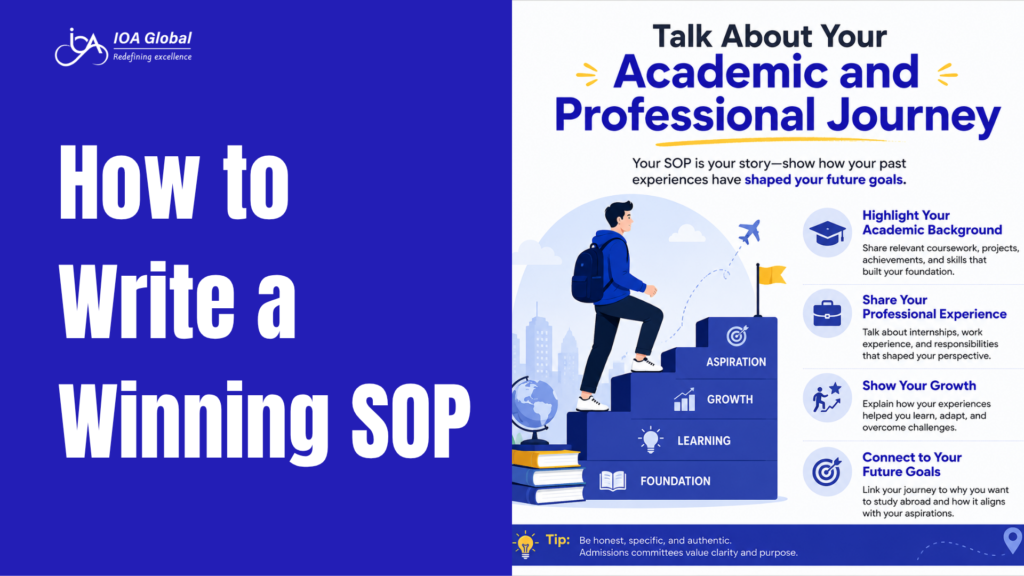
Once you have established your interest in the field, transition into your educational background and work experience.
Discuss the subjects you studied, projects you worked on, internships you completed, or professional responsibilities that strengthened your understanding of the field. Rather than simply listing tasks, focus on what you learned from these experiences and how they shaped your perspective.
For instance, if you worked in Finance, you could talk about a specific project that introduced you to financial modelling, budgeting, or risk analysis. Explain how the experience helped you develop analytical thinking, problem-solving abilities, or a deeper appreciation for the industry.
If your work exposed you to international clients, cross-cultural collaboration, or global business environments, mention how these experiences broadened your worldview and enhanced your adaptability.
This section should show growth, both personally and professionally.
3. Highlight Your Interests Beyond Academics and Work
Your extracurricular interests can reveal a lot about your personality and passion.
Universities appreciate students who go beyond the classroom and actively engage with their interests independently. So ask yourself: what do you enjoy doing outside your formal education or job?
Do you actively trade in the stock market? Maintain a blog related to your field? Freelance, volunteer, or participate in competitions? Have you completed independent certifications or side projects?
Including such details demonstrates initiative, curiosity, and commitment. It shows that your interest in the field is not limited to textbooks or office work, it is something you genuinely enjoy exploring.
4. Clearly Define Your Short-Term and Long-Term Goals
This is arguably the most important part of your SOP if you want your dream study abroad college.
Admissions committees want to understand whether you have clarity about your future and whether their program can genuinely help you achieve your goals. Therefore, be very specific about where you see yourself in the next 3 years and 5–10 years.
If you want to start your own business, explain the problem you hope to solve and what makes your idea unique. If you plan to work in a corporate role, specify the industry, department, or area you are interested in whether it is project financing, consulting, budgeting, analytics, or investment management.
Avoid vague statements like “I want to be successful” or “I want to gain knowledge.” Instead, show direction and intention.
Finally, connect your goals back to the program by explaining how the course will help bridge the gap between where you are today and where you aspire to be in the future.
5. Explain Why You Chose This Particular Course and University
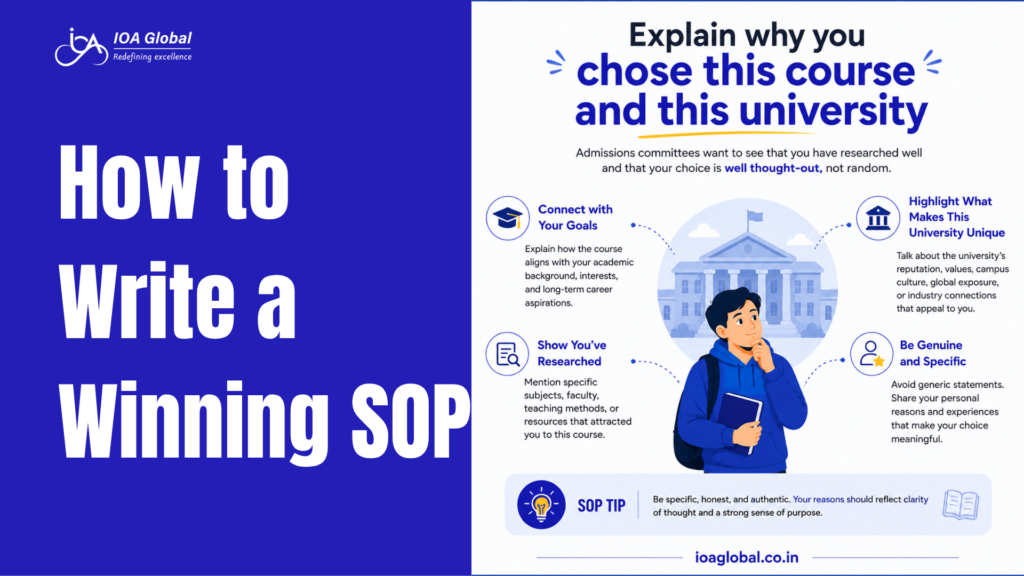
Remember, universities in abroad receive thousands of applications every year from students applying to similar program. Simply saying “this university has a great reputation” is not enough.
You need to demonstrate that you have thoroughly researched the program and understand what makes it unique.
Look into the curriculum, teaching methodology, electives, research opportunities, specializations, faculty, student organizations, and industry exposure offered by the university.
For example:
- Does the program combine Finance with technology or data analytics?
- Does it include modules on project management or entrepreneurship?
- Are there opportunities for practical learning through consulting projects or internships?
- Does the university have research centers, finance clubs, or entrepreneurship cells that align with your interests?
Mention professors whose work you admire and explain why their research interests you. If the program offers specialized pathways, discuss which one you would choose and how it aligns with your career goals.
This section shows the admissions committee that your application is intentional and well thought out.
6. Explain How You Can Contribute to the University Community
An SOP should never focus only on what the university can do for you. Universities also want students who can actively contribute to the institution and its community.
Think about the skills, experiences, perspectives, and ideas you can bring to campus.
For instance:
- If you enjoy writing, you could contribute by creating a weekly newsletter related to your field.
- If you have leadership experience, you could discuss how you would like to organize workshops, competitions, or networking events.
- If you have volunteered for NGOs or social initiatives, you could talk about introducing community-driven projects or awareness campaigns on campus.
Be realistic and practical while discussing your contributions. The goal is to show initiative and collaboration.
7. Talk About the Social Impact You Hope to Create
Many applicants overlook this section, but universities often value students who want to create meaningful change in society.
Think about the larger impact you want your education and career to have.
Are there specific social issues that resonate with you? Have you already taken steps to contribute toward solving them? How do you plan to continue this work in the future?
For example, if women’s empowerment is important to you, you could discuss how you hope to support women-led initiatives, mentor aspiring female entrepreneurs, or contribute financially to organizations working in this space.
This section helps universities understand your values, empathy, and broader vision beyond career success.
8. End with a Powerful and Memorable Conclusion
Your conclusion should bring your entire SOP together and leave the admissions committee with a strong final impression. Being one of the best study abroad consultants in Delhi, IOA Global helps students with writing an effective SOP along with other services.
Highlight your unique strengths, experiences, and qualities that distinguish you from other applicants. Perhaps it is your leadership experience, diverse professional background, entrepreneurial mindset, or ability to adapt across industries and cultures.
End on a confident and forward-looking note by reinforcing how the program will help you achieve your aspirations while also allowing you to contribute meaningfully to the university community.
For example:
“My diverse experiences have helped me develop a holistic understanding of business, adaptability, and leadership. I am confident that pursuing a master’s in XYZ will equip me with the knowledge, global exposure, and practical skills required to achieve my long-term goals and create meaningful impact in my field.”
At its core, a great SOP is not about sounding overly formal or trying to impress the reader with complex language. It is about telling your story honestly and thoughtfully. When written with authenticity, clarity, and purpose, your SOP becomes far more than just another application document- it becomes a reflection of who you are and where you hope to go.
For more such blogs or a straight dive into getting counseled by experts, visit IOA Global.

Leave A Comment