

IELTS Coaching in Delhi: How to Score An 8 Band in IELTS
Scoring an 8 Band in IELTS is an ambitious goal, but it is entirely achievable with the right preparation strategy, consistent practice, and a clear understanding of how the exam is evaluated. Whether you’re planning to study in the UK, Ireland, Australia, New Zealand, or Germany, a high IELTS score can strengthen your university application, improve your chances of meeting admission requirements, and even make you more competitive for scholarships at certain institutions.
Many students assume that achieving 8 Band requires exceptional English skills or months of intensive IELTS coaching. In reality, success in IELTS depends just as much on understanding the exam format, avoiding common mistakes, managing your time effectively, and practising with the right techniques as it does on language proficiency.
In this guide, you’ll learn what an IELTS 8 Band score means, how each section of the exam is assessed, practical strategies to improve your performance, common pitfalls to avoid, and a structured preparation approach to help you achieve your target score with confidence.
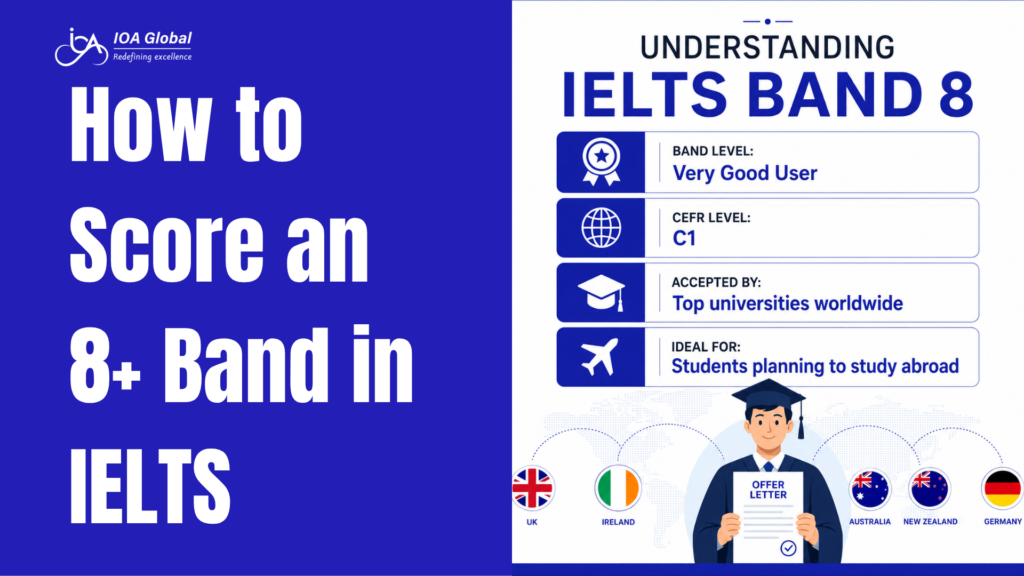
What is an IELTS 8 Band Score?
An IELTS 8 Band indicates that you are fluent with the English language. According to the official IELTS band descriptors, a 8 Band scorer demonstrates excellent command of English with only occasional unsystematic inaccuracies or misunderstandings in unfamiliar situations. This score is widely accepted by leading universities in the UK, Ireland, Australia, New Zealand, and many other countries, making it an excellent target for students planning to study abroad.
What Does an IELTS 8 Band Score Mean?
An IELTS 8 Band reflects a very high level of English language proficiency. According to the official IELTS band descriptors, an 8 Band candidate is considered fluent with English, demonstrating excellent communication skills with only occasional inaccuracies in unfamiliar situations.
However, scoring 8 Band isn’t about speaking perfect English or using difficult vocabulary in every sentence. Instead, it shows that you can understand complex ideas, express your thoughts clearly, organise your responses logically, and communicate naturally across all four sections of the exam.
For students planning to study abroad, an 8 Band score is more than just a number. It demonstrates to universities that you can confidently participate in lectures, write academic assignments, contribute to classroom discussions, and adapt to an English-speaking academic environment. While every university sets its own language requirements, an 8 Band score comfortably exceeds the minimum English proficiency requirements for most undergraduate and postgraduate programmes.
What Examiners Look for in an 8 Band Candidate
To achieve an overall 8 Band, your performance is assessed against specific criteria in each section of the IELTS exam.
Listening
- Understand both direct and implied meanings.
- Follow conversations even when speakers have different accents.
- Identify specific details without missing important information.
Reading
- Read quickly without sacrificing accuracy.
- Understand arguments, opinions, and implied meanings.
- Locate information efficiently under time pressure.
Writing
- Respond fully to the question.
- Present ideas in a logical sequence.
- Use a wide range of vocabulary naturally.
- Demonstrate strong grammatical control with only minor errors.
Speaking
- Speak confidently without memorised responses.
- Develop answers with relevant examples.
- Use varied vocabulary appropriately.
- Maintain fluency even when discussing unfamiliar topics.
7 Band vs 8 Band: What’s the Difference?
Many students consistently score 7 Band and wonder why they struggle to reach Band 8. The difference often isn’t knowledge, it’s consistency.
| Band 7 | Band 8 |
| Good English with noticeable mistakes | Very good English with only occasional errors |
| Vocabulary is varied but sometimes repetitive | Vocabulary is flexible, accurate, and natural |
| Minor issues with fluency or organisation | Ideas flow smoothly and logically |
| Grammar is generally accurate but inconsistent | Strong grammatical control across complex sentences |
| May lose marks under pressure | Performs consistently throughout the test |
The jump from Band 7 to Band 8 requires refining your exam strategy, improving accuracy, and avoiding small mistakes that cost valuable marks.
Common Myths About Scoring Band 8
1. Understand the IELTS Band Descriptors Before You Begin
One of the biggest mistakes students make is preparing without knowing how IELTS exam is actually marked.
Each section of IELTS has specific assessment criteria. For example:
- Writing is evaluated on Task Achievement, Coherence and Cohesion, Lexical Resource, and Grammatical Range and Accuracy.
- Speaking is assessed on Fluency and Coherence, Pronunciation, Lexical Resource, and Grammar.
- Listening is assessed based on the number of correct answers out of 40, which are then converted into an IELTS band score. There are no separate assessment criteria for Listening.
- Reading is also assessed based on the number of correct answers out of 40, which are converted into an IELTS band score. The band score conversion differs slightly between the Academic and General Training versions.
Pro Tip: Before solving practice papers, spend time reviewing the official assessment criteria so you know exactly where marks are awarded.
2. Build a Consistent Study Routine
Studying for long hours occasionally is less effective than practising consistently every day.
Aim for 2-3 hours of focused preparation daily, divided across all four modules.
A balanced weekly routine could include:
| Day | Primary Focus |
| Monday | Listening + Vocabulary |
| Tuesday | Reading Practice |
| Wednesday | Writing Task 1 |
| Thursday | Speaking Practice |
| Friday | Writing Task 2 |
| Saturday | Full-Length Mock Test |
| Sunday | Error Analysis & Revision |
Consistency builds familiarity with the exam and improves confidence over time.
3. Practise Under Real IELTS Exam Conditions
Many students perform well during practice but struggle on exam day because they aren’t used to working under time pressure.
At least once a week:
- Attempt a complete IELTS mock test. Many IELTS coaching in Delhi offer free and paid mock tests. You can also find mock tests online, but many free versions do not provide accurate scoring or personalised feedback.
- Follow the official IELTS time limits:
- Listening: 30 minutes (+ 10 minutes to transfer answers in the paper-based test)
- Reading: 60 minutes
- Writing: 60 minutes (Recommended: 20 minutes for Task 1 and 40 minutes for Task 2)
- Speaking: 11–14 minutes
- Avoid using dictionaries, translation tools, AI, or any external assistance during the test to accurately assess your current proficiency.
- Review every mistake after completing the test. Analyse incorrect answers, identify weak areas, and discuss your performance with your teacher, faculty, or IELTS mentor to receive constructive feedback and improve before your next mock test.
Mock tests help improve speed, accuracy, and time management- three essential skills for achieving Band 8.
-
Focus on Accuracy Before Speed
Rushing through questions often leads to avoidable mistakes.
Instead of trying to answer quickly from the beginning:
- Read instructions carefully.
- Identify keywords.
- Double-check spellings.
- Review your answers whenever time permits.
Example:
What normal students do:
- Read the question once and answer immediately.
- Skip the instructions.
- Panic when they don’t know an answer.
- Leave spelling and grammar unchecked.
- Finish quickly without reviewing.
What 8 Band students do:
- Read the instructions and question carefully before answering.
- Underline or identify important keywords.
- Eliminate incorrect options before making a choice.
- Check spelling, grammar, and answer format.
- Use any remaining time to review and correct mistakes before submitting.
As your accuracy improves, your speed will naturally increase.
5. Strengthen Your Vocabulary Naturally
A strong vocabulary doesn’t mean memorising hundreds of difficult words.
Instead, focus on:
- Academic vocabulary commonly used in IELTS.
- Collocations (words that naturally go together).
- Synonyms and paraphrasing techniques.
- Context-based learning through newspapers, podcasts, and articles.
Example:
What normal students do:
Learns 500 difficult words the night before the test.
What 8 IELTS Band students do:
Reads news articles, listens to podcasts, and learns new words in context every day.
Using vocabulary naturally is far more valuable than forcing complex words into every answer.
6. Improve Your Grammar Through Daily Writing
Grammar remains one of the biggest scoring factors in both Writing and Speaking.
Develop the habit of writing a short paragraph every day on a different topic.
After writing:
- Check sentence structure.
- Identify repeated grammatical mistakes.
- Rewrite weak sentences.
- Compare your answer with 8 Band sample responses.
Example:
What normal students do:
Writes → Submits → Forgets.
What Band 8+ students do:
Writes → Reviews → Corrects → Rewrites → Improves
Small improvements made consistently lead to significant score gains over time.
7. Read Beyond IELTS Practice Books
Reading only IELTS passages limits your exposure to different writing styles.
Include:
- Newspaper editorials (The Hindu, Times of India, The Guardian)
- Academic articles (Google Scholar, JSTOR (Open Content), The Conversation, Nature Research Highlights)
- Science magazines (Scientific American, National Geographic, New Scientist, BBC Science Focus)
- Business publications (Harvard Business Review (HBR), The Economist, Bloomberg, Financial Times)
- University blogs (Harvard University News, MIT News, University of Oxford News, Stanford News, Cambridge University Research)
This improves reading speed, comprehension, and vocabulary simultaneously.
8. Listen to Different English Accents
The Listening section includes speakers with different accents.
Practise listening to:
- British English
- Australian English
- Canadian English
- New Zealand English
Exposure to different accents reduces surprises during the exam and improves comprehension.
9. Record Yourself During Speaking Practice
Many candidates don’t realise their weaknesses until they hear themselves.
Record your responses and evaluate:
- Fluency
- Pronunciation
- Hesitation
- Grammar
- Repetition of words
This simple habit often leads to noticeable improvements in confidence and delivery.
10. Analyse Every Mistake
Practice alone doesn’t guarantee progress.
After every mock test, ask yourself:
- Why did I lose marks?
- Was it a vocabulary issue?
- Did I misread the question?
- Did I run out of time?
- Was my grammar inaccurate?
Keeping an error journal helps you avoid repeating the same mistakes.
11. Prioritise Quality Over Quantity
Completing twenty mock tests without reviewing them is less effective than thoroughly analysing five.
Focus on understanding ‘why’ an answer is correct or incorrect rather than simply checking your score.
Thoughtful practice produces better long-term results than repetitive practice.
12. Stay Calm on Test Day
Even well-prepared students lose marks because of anxiety.
On the day of your exam:
- Arrive early.
- Read every instruction carefully.
- Manage your time wisely.
- Stay composed if you encounter a difficult question.
- Move forward and return later if necessary.
Confidence and composure can make a significant difference in your final score.
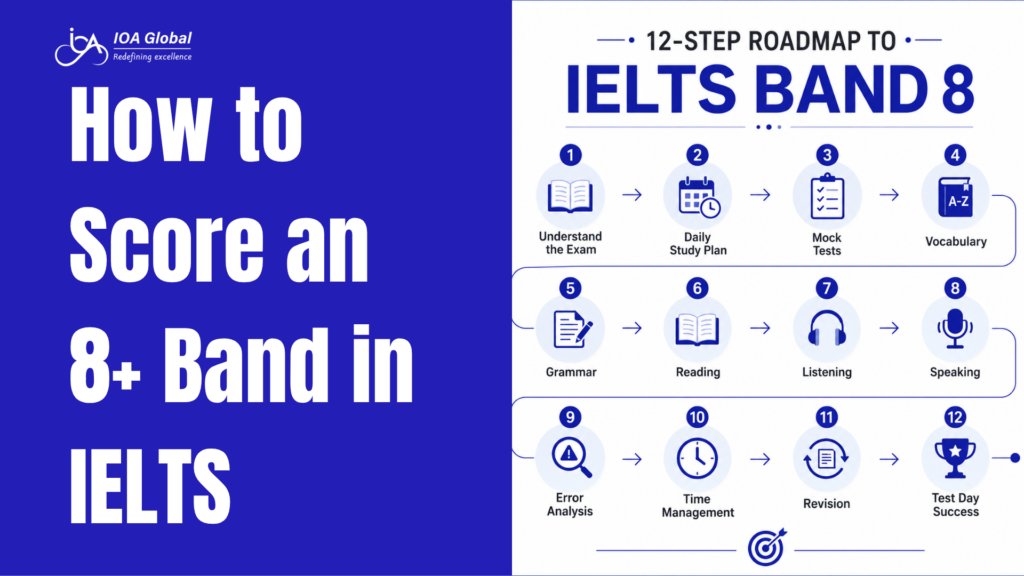
Expert Tip
Preparing for IELTS is not just about improving your English, it’s about understanding the exam. Students who consistently achieve 8 Band treat every practice session as an opportunity to refine their strategy, identify weaknesses, and improve steadily. With consistent effort and the right approach, reaching your target score becomes a realistic and achievable goal.
Common Mistakes That Prevent Students from Achieving an IELTS Band 8
Many students preparing for the IELTS exam put in months of hard work but still struggle to move beyond Band 6.5 or 7.0. In most cases, the problem isn’t a lack of effort, it’s an ineffective preparation strategy. Understanding these common mistakes can help you make better use of your study time and improve your chances of achieving an 8 Band.
Whether you’re preparing independently or through Best IELTS coaching in Delhi, recognising these pitfalls early can save valuable time and help you focus on the areas that matter most.
1. Studying Without Understanding the Band Descriptors
One of the biggest mistakes students make is preparing without knowing how the IELTS exam is actually assessed. For example, many candidates believe that using advanced vocabulary alone will improve their Writing score, when in reality, examiners evaluate multiple criteria, including task achievement, coherence, grammar, and lexical resource.
A structured IELTS preparation plan should always begin with understanding the official marking criteria so you know exactly what examiners expect in each module.
2. Ignoring Mock Tests
Many students spend weeks reading books and watching videos but avoid taking full-length mock tests until the last minute.
Mock tests help you:
- Improve time management.
- Identify recurring mistakes.
- Build confidence under exam conditions.
- Understand your current band level.
One of the biggest advantages of joining IELTS classes is access to regular mock tests followed by personalised feedback, helping you improve steadily before the actual exam.
3. Memorising Answers Instead of Building Skills
Memorised Speaking responses and pre-written Writing essays are easy for experienced examiners to identify.
Instead of trying to sound impressive, focus on expressing your ideas naturally and confidently. Genuine communication is always rewarded more than rehearsed answers.
4. Neglecting Vocabulary in Context
Learning long lists of unfamiliar words rarely leads to higher scores.
Instead, build your vocabulary through newspapers, podcasts, books, and academic articles. Pay attention to how words are used in real situations, and practise incorporating them naturally into your Writing and Speaking responses.
This approach is far more effective than memorisation and is often emphasised during professional IELTS training programmes.
5. Focusing Only on Strong Areas
It’s natural to spend more time practising the sections you enjoy. However, your overall IELTS score depends on performance across all four modules.
If Reading is your strongest area but Writing remains weak, your overall band score may still suffer. A balanced study plan ensures that every module receives adequate attention.
6. Not Reviewing Mistakes
Completing practice papers without analysing your errors is one of the slowest ways to improve.
After every mock test, ask yourself:
- Why did I lose marks?
- Was it a grammar mistake?
- Did I misunderstand the question?
- Did I run out of time?
- Could I have organised my ideas better?
Keeping an error log helps you avoid repeating the same mistakes and makes every practice session more productive.
7. Waiting Too Long to Seek Guidance
Many students spend months preparing independently before realising they’re repeating the same mistakes.
If your scores remain unchanged despite consistent practice, personalised feedback can make a significant difference. Joining an experienced IELTS coaching centre gives you access to expert trainers who can identify weaknesses, suggest targeted improvements, and help you develop effective exam strategies.
For students in the capital, enrolling in a reputed IELTS coaching centre in Delhi can also provide regular mock tests, interactive classroom discussions, and one-to-one mentoring that are difficult to replicate through self-study alone.
Expert Tip
Don’t measure your preparation by the number of hours you study, measure it by the progress you make after every practice session. The most successful IELTS candidates continuously evaluate their performance, refine their strategies, and work on their weaknesses rather than repeating the same exercises every day.
If you’re aiming for a competitive 8 Band score and feel that self-study isn’t delivering the desired results, learning under experienced mentors through a structured IELTS coaching programme can help you prepare more efficiently with personalised guidance and a clear roadmap.
30-Day IELTS 8 Band Study Plan
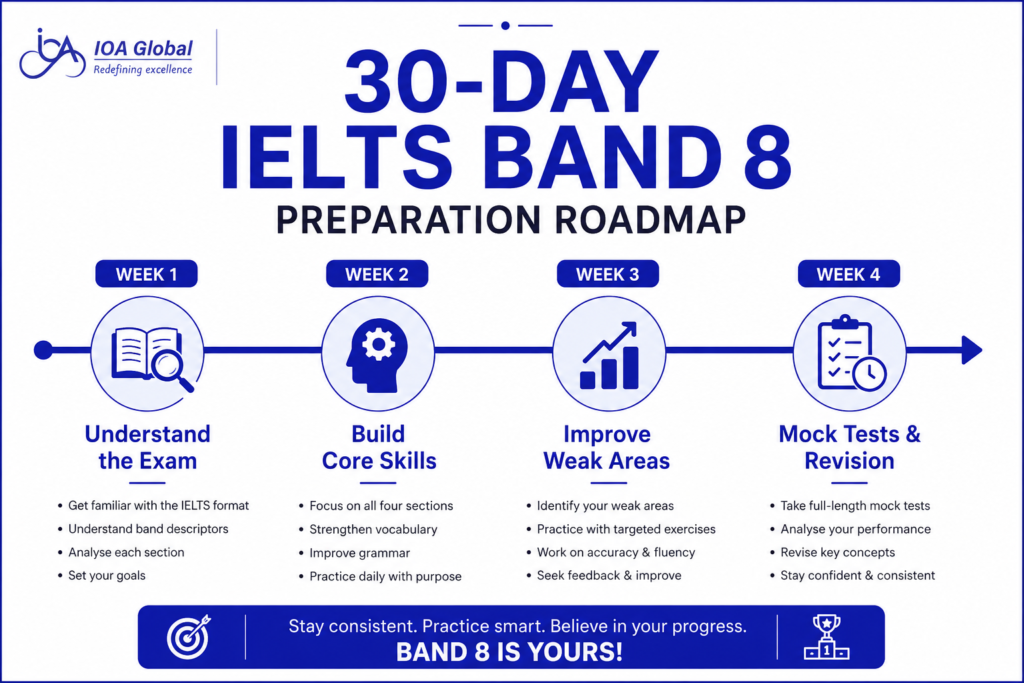
A well-structured study plan is one of the biggest factors that separates successful candidates from those who struggle to improve their scores. Rather than studying randomly, divide your preparation into manageable weekly goals that focus on building skills, identifying weaknesses, and improving test-taking confidence.
Whether you’re following a self-study routine or enrolled in an IELTS coaching programme, having a clear plan ensures that every study session contributes towards your target 8 Band score.
Daily Study Routine for 8 Band
Here’s an example of how you can structure a productive study day:
| Time | Activity |
| 30 Minutes | Vocabulary and Grammar Practice |
| 45 Minutes | Listening Practice |
| 45 Minutes | Reading Practice |
| 60 Minutes | Writing Task 1 or Task 2 |
| 30 Minutes | Speaking Practice |
| 30 Minutes | Review Mistakes and Revise |
Self-Study vs IELTS Coaching: Which Is Better?
Many students successfully prepare on their own, especially when they have strong English language skills and a disciplined study routine. However, self-study also comes with certain limitations, particularly when it comes to receiving personalised feedback on Writing and Speaking.
Here’s a quick comparison:
| Self-Study | IELTS Coaching |
| Flexible schedule | Structured learning plan |
| Lower cost | Expert guidance and personalised feedback |
| Free online resources | Regular mock tests and performance tracking |
| Requires self-discipline | Trainer-led improvement strategies |
| Limited feedback | Individual attention on Writing and Speaking |
 If you’re consistently scoring between Band 6.5 and 7 despite regular practice, joining a structured IELTS coaching centre can help you identify the specific issues preventing you from reaching 8 Band.
For students looking for IELTS coaching in Delhi, choosing an institute that offers experienced trainers, small batch sizes, regular mock tests, and personalised mentoring can make your preparation more focused and effective.
Need a personalised study plan? Explore IOA Global’s IELTS Preparation programmes, where experienced trainers create customised learning plans, conduct regular mock tests, and provide detailed feedback to help students achieve their target scores.
Frequently Asked Questions About Scoring an IELTS Band 8
1. Is it difficult to score Band 8 in IELTS?
Scoring 8 Band is challenging, but it is certainly achievable with the right preparation strategy. Most candidates who achieve this score combine consistent practice with a clear understanding of the IELTS assessment criteria. A structured IELTS preparation plan, regular mock tests, and focused feedback on weaker areas can significantly improve your chances of reaching 8 Band.
2. How long does it take to prepare for 8 Band in IELTS?
The preparation time depends on your current level of English proficiency. Students with strong English skills may need 6-8 weeks of focused preparation, while others may require 3-6 months. Following a structured study schedule or joining IELTS classes can help you prepare more efficiently by providing expert guidance and regular assessments.
3. Can I score 8 Band without joining IELTS coaching?
Yes. Many students achieve 8 Band through disciplined self-study using quality resources and regular practice. However, if you’re struggling to improve your Writing or Speaking scores despite consistent effort, professional IELTS coaching can provide personalised feedback, mock interviews, and exam strategies that are difficult to replicate on your own.
4. Which IELTS module is the most difficult?
The answer varies from student to student. Many candidates find Writing the most challenging because it requires strong grammar, organisation, vocabulary, and time management. Others struggle with Reading due to time constraints. Identifying your weakest module early allows you to allocate more time to it during your IELTS preparation.
5. Is coaching necessary to achieve 8 Band?
Coaching is not mandatory, but it can accelerate your progress. A good IELTS coaching centre provides structured lessons, expert feedback, regular mock tests, and personalised improvement plans. If you’ve been stuck at Band 6.5 or 7 despite repeated attempts, professional guidance can help bridge the gap.
6. How many hours should I study every day?
For most students, 2-4 hours of focused study is sufficient, provided the time is used effectively. Rather than studying for long hours, aim for consistent daily practice across Listening, Reading, Writing, and Speaking. Quality of preparation is always more important than quantity.
7. What are the best resources for IELTS preparation?
Some of the most trusted IELTS preparation resources include official Cambridge IELTS practice books, IELTS Ready by IDP, and authentic English-language newspapers, podcasts, and academic articles. If you prefer guided learning, enrolling in IELTS training with experienced instructors can help you stay accountable and receive regular feedback.
8. What should I do if my score is stuck at Band 6.5 or 7?
Plateauing at Band 6.5 or 7 is common. Instead of taking more practice tests, analyse your previous performance to identify recurring mistakes. Many students find that personalised feedback from experienced trainers at an IELTS coaching centre in Delhi or online helps them overcome specific challenges in Writing and Speaking.
9. Which is the best IELTS coaching in Delhi?
The best institute is one that offers experienced trainers, personalised feedback, regular mock tests, updated study material, and small batch sizes. Before enrolling, compare teaching methods, student reviews, and the level of individual attention provided. Choosing the best IELTS coaching in Delhi should depend on the quality of instruction and support rather than advertisements alone.
10. Does an 8 Band IELTS score increase my chances of studying abroad?
An 8 Band score demonstrates a very high level of English proficiency and exceeds the minimum language requirements for many universities. While admission depends on several factors, including academic performance, your Statement of Purpose (SOP), Letters of Recommendation (LORs), and overall profile- a strong IELTS score can strengthen your application and make you eligible for a wider range of programmes.

Achieving an IELTS 8 Band requires more than just good English, it demands consistency, smart preparation, and a clear understanding of how the exam is assessed. By following a structured study plan, practising under real exam conditions, reviewing your mistakes, and improving each module systematically, you can steadily work towards your target score.
If you find yourself struggling despite regular practice, don’t hesitate to seek expert guidance. The right support can help you identify blind spots, refine your strategy, and prepare more efficiently.
Whether you choose self-study or enroll in a professional IELTS coaching in Delhi, the key is to stay disciplined, track your progress, and keep learning from every practice session.

Leave A Comment