
Study in Ireland for Indian Students
It’s almost ironic how students largely remain unaware of the Study in Ireland for Indian Students 2026 opportunities right at their doorstep.
Ireland is one such country that remains off the students’ radar when they are searching for study abroad destinations. And most likely due to the same reason, they are clueless about its geographical location, as well.
Study in Ireland: The Geographical Location & Other Stats
Ireland is an independent European country located right next to the UK, offering the advantage of both UK proximity and full access to the European Union, making it one of the most strategically placed destinations for international students.
Ireland does not just rank among the top study abroad destinations for Indian students but is also ranked second on the 2025 Global Peace Index- which speaks volume about how it prioritizes happiness and culture despite scaling up the development chart.
Ireland ranks among the top 5 wealthiest countries when it comes to income per capita. If this wasn’t enough then as of 2025, Ireland was identified as the most educated country globally, with 52.4% of 25-64 year-olds holding a bachelor’s degree or higher.
Fun Academic Facts about Study in Ireland
- As of 2025, Ireland had 44,500 international students studying there, with Indians making up for the maximum of the lot.
- The primary reasons behind such great footfall can be attributed to the fact that 100% Irish universities fall under top 5% globally.
- The number of Indian students in Ireland rose from 700 in 2016 to 9000 in 2026, which is a 1200% increase in the last 10 years!
The Irish Education System
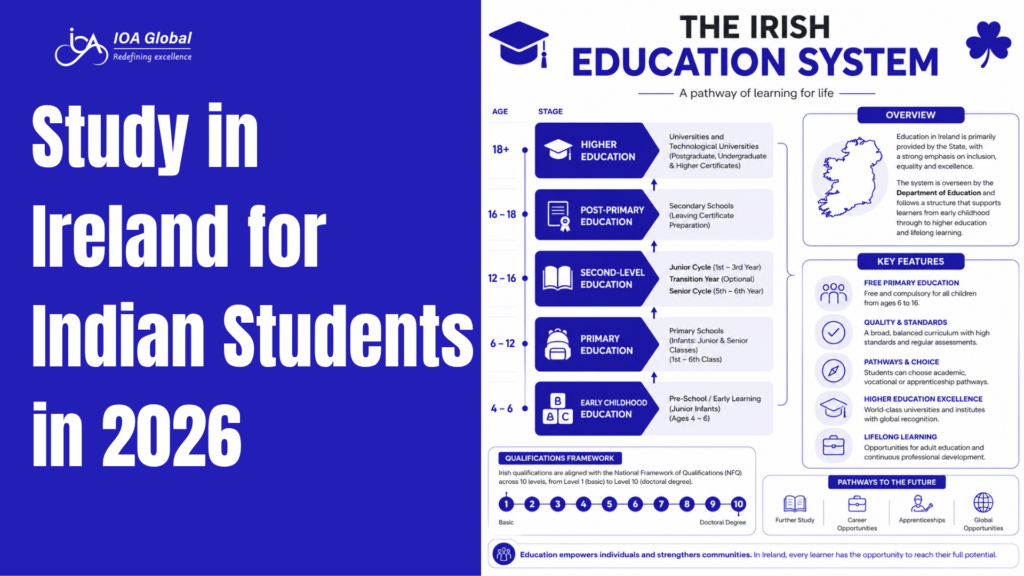
The Education System in Ireland is a globally trusted and internationally recognized system consisting of universities, technological institutes and private colleges and therefore heightens the need for a top study abroad consultants to guide you through the same.
- 7 of its universities rank among the top 500 universities globally.
- Bachelor degrees are usually 3-4 years long.
- Master’s degrees are usually 1-2 years long.
- PhD programmes generally take 3-4 years to complete.
- The medium of instruction is also English.
Graduates can apply for the Third Level Graduate Scheme, which permits them to stay & study in Ireland to seek employment for up to two years after graduating.
As per ireland.ie , Ireland has become a global research leader in areas such as
- chemistry
- nanotechnologyimmunology
- agriculture
- materials science
- mathematics
The Higher Education Institutions
Universities
Ireland has eight public universities:
- Trinity College Dublin
- University College Dublin
- University College Cork
- University of Galway
- University of Limerick
- Dublin City University
- Maynooth University
- Technological University Dublin
And as of 2026, all eight feature among the world’s top 800 in the QS World University Rankings for the first time, with seven of the eight climbing the global table this year, driven by improvements in employer reputation and a rising proportion of international staff and students. Trinity leads the country at 75th globally, followed by UCD at 118th, UCC at 246th, University of Galway at 284th, University of Limerick at 401st, Dublin City University at 410th, Maynooth University at 771–780th, and Technological University Dublin at 781–790th. Irish universities offer both undergraduate and postgraduate program across a wide range of disciplines, and most maintain dedicated international offices that support overseas students with settling into academic life and participating in campus activities.
Technological Universities and Institutes of Technology
Ireland’s higher education sector has changed significantly in recent years. Until 2018, Ireland had fourteen colleges using the title Institute of Technology, and following reforms under the Technological Universities Act 2018, most of these merged to form Technological Universities. As of 2026, Ireland has five Technological Universities
- Technological University Dublin: the first, designated in January 2019 following the merger of Dublin Institute of Technology, Institute of Technology Blanchardstown, and Institute of Technology Tallaght
- Munster Technological University: established January 2021 from the merger of Cork Institute of Technology and Institute of Technology Tralee
- Technological University of the Shannon- Midlands Midwest: established October 2021 from the merger of Athlone Institute of Technology and Limerick Institute of Technology
- Atlantic Technological University: established April 2022 from the merger of Galway-Mayo Institute of Technology, Institute of Technology Sligo, and Letterkenny Institute of Technology
- South East Technological University (SETU): formed from the merger of Waterford Institute of Technology and Institute of Technology Carlow
Only two independent Institutes of Technology now remain: Dundalk Institute of Technology and Dún Laoghaire Institute of Art, Design and Technology (IADT). These institutions provide programmes in areas such as business, science, engineering, computing, and the arts, with qualifications available at certificate, diploma, and degree levels.
Colleges of Education
Colleges of Education prepare students for careers in teaching. Primary school teaching can be pursued through a Bachelor of Education degree or a postgraduate teacher education programme. Those intending to teach at secondary school level generally complete a degree in their chosen subject before undertaking a postgraduate teaching qualification.
Private Colleges
Private colleges in Ireland offer specialised education in areas including business, law, medicine, vocational training, and agriculture. They provide qualifications at vocational, certificate, diploma, and degree levels.
English Language Requirements
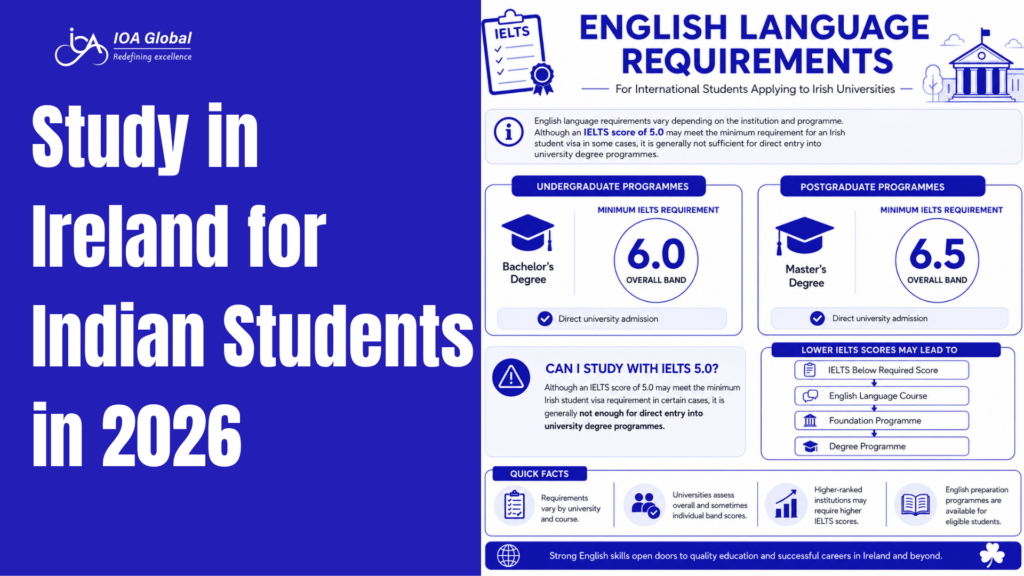
English language requirements vary depending on the institution and programme. Although an IELTS score of 5.0 may meet the minimum requirement for an Irish student visa in some cases, it is generally not sufficient for direct entry into university degree programmes. Most universities typically require:
- Undergraduate programmes: overall IELTS score of 6.0
- Postgraduate programmes: overall IELTS score of 6.5
Lower scores may only qualify students for foundation or English language preparatory courses rather than direct admission into degree programmes.
The IELTS Coaching Center at IOA Global can help students significantly improve their IELTS Band.
Popular Courses in Ireland for Indian Students in 2026
For the 2026 intake, Ireland continues to attract Indian students with programmes that align strongly with global industry demand and career opportunities. Some of the most sought-after fields include:
- Data Science and Business Analytics
- Computer Science and Software Engineering
- Business, Management, and Finance
- Biotechnology and Pharmaceutical Sciences
- Environmental Science and Renewable Energy
- Digital Marketing, Media, and Communications
- Engineering and Technology Hospitality, Tourism, and Event Management
These courses are especially popular because of Ireland’s strong presence of multinational companies, growing research ecosystem, post-study work opportunities, and industry-focused education system.
Cost of Studying in Ireland
The cost of studying in Ireland depends on the university, course, and level of study. Generally, programmes in humanities, arts, and education tend to be more affordable, while courses such as medicine, engineering, business, and technology are usually more expensive. Postgraduate programmes may also have higher tuition fees depending on the specialisation and institution.
| S. No. | Study Programme | Average Annual Tuition Fees* |
|---|---|---|
| 1 | Undergraduate Degree | €10,000 – €30,000 |
| 2 | Postgraduate Master’s Degree | €10,000 – €35,000 |
| 3 | Doctoral (PhD) Degree | €9,000 – €30,000 |
*Tuition fees are approximate and may vary depending on the university, course, and intake year. Additional living expenses such as accommodation, food, transport, and health insurance should also be considered.
Scholarships for Indian Students in Ireland
Indian students planning to study in Ireland can apply for several scholarships offered by the Irish government and universities. Some of the most popular options include:
| S. No. | Scholarship Name | Description |
|---|---|---|
| 1 | Government of Ireland International Education Scholarship (GOI-IES) | This prestigious scholarship is offered by the Irish government to outstanding international students pursuing Bachelor’s, Master’s, or PhD programmes at eligible Irish higher education institutions. Selected students typically receive a €10,000 stipend for one year of study along with a full tuition fee waiver and registration cost coverage. |
| 2 | University Scholarships | Many Irish universities offer merit-based and programme-specific scholarships for international students. These scholarships commonly range between €2,000 and €5,000, though some institutions may provide higher awards depending on academic performance and eligibility criteria. |
Scholarship availability, eligibility, and funding amounts may vary each year based on the institution and programme.
For more such information refer to the blog section of IOA Global

Leave A Comment