

Part-Time Work for Study Abroad Students
For thousands of students every year, the dream of studying abroad extends beyond earning a globally recognised degree.Many of the world’s leading study destinations, including the UK , Australia, Ireland, Germany, New Zealand allow eligible international students to work while pursuing their education, subject to the conditions of their student visa. These opportunities not only help students offset a portion of their living expenses but also provide valuable exposure to local workplaces, strengthen communication and interpersonal skills, and enhance employability after graduation. Immigration authorities across these countries recognise that practical work experience can complement classroom learning when undertaken within the limits of the law.
However, working while studying abroad is not as simple as finding a part-time job. Every country has its own immigration rules, work-hour restrictions, taxation requirements, minimum wage regulations, and university policies. In some destinations, students can work only a specified number of hours during academic sessions and more during scheduled breaks. Others impose annual work limits or require students to remain enrolled in eligible programmes to access employment rights. Understanding these regulations is essential, as exceeding the permitted work limits can affect visa compliance and, in serious cases, immigration status.
Students also have practical concerns beyond visa rules. Is it possible to earn enough to manage monthly expenses? Which jobs offer the highest hourly pay? Do employers require prior experience? Is knowledge of the local language necessary? How can students balance academics with employment without compromising their grades? These are some of the most frequently asked questions by Indian and international students planning to pursue overseas education.
This comprehensive guide answers all of these questions with accurate, up-to-date information for 2027. You’ll learn about student work rights across popular destinations, average hourly earnings, the best and highest-paying part-time jobs, visa regulations, work opportunities during semester breaks, language requirements, and strategies for balancing work with academics. Whether you plan to study in UK, study in Australia, study in Ireland, study in Germany, or study in New Zealand, this guide will help you understand how part-time employment fits into your overall study abroad journey.
Choosing the right country, university, and career pathway requires careful planning. Beyond comparing tuition fees and university rankings, students should evaluate employment opportunities, cost of living, post-study work options, and long-term career prospects. Seeking guidance from experienced Study Abroad Consultants can simplify this process and help you make informed decisions based on your academic goals and budget. At IOA Global, our experienced counsellors provide personalised support for university selection, admissions, scholarships, visa applications, and career planning, ensuring students are well prepared before beginning their international education journey.
Can International Students Work on a Student Visa?
One of the most common questions students ask before planning their overseas education is whether they are legally allowed to work while studying. The answer is yes, most popular study destinations permit eligible international students to work part-time while their course is in session and, in many cases, full-time during official academic breaks. However, these work rights are governed by the conditions of your student visa and vary from country to country.
It is important to understand that a student visa is issued primarily for education, not employment. Part-time work is intended to supplement your living expenses, provide practical work experience, and help you integrate into the local community. It should never interfere with your academic progress or breach the conditions of your visa.
Student Visa Work Rights by Country
The table below provides an overview of the current work rights available to international students in some of the most popular study abroad destinations.
| Country | Can Students Work? | Typical Work Rights |
| United Kingdom | Yes |
Up to 20 hours per week during term and full-time during official vacations for eligible degree-level students.
|
| Australia | Yes |
Up to 48 hours per fortnight during study periods and unlimited hours during recognised course breaks.
|
| Ireland | Yes |
Up to 20 hours per week during term and up to 40 hours during designated holiday periods for eligible students.
|
| Germany | Yes |
International students may work within annual limits prescribed under German law (generally expressed as working days per year).
|
| New Zealand | Yes |
Eligible students can work up to 25 hours per week during study and full-time during scheduled breaks.
|
| France | Yes |
Students may work up to the annual limit permitted under French labour regulations.
|
| Singapore | Yes |
Eligible students enrolled at approved institutions can work part-time during term and full-time during vacations, subject to government rules.
|
| UAE (Dubai) | Yes |
Work opportunities are available subject to student visa conditions, institutional requirements, and local labour regulations.
|
Who Is Eligible to Work?
Although eligibility differs between countries, international students are generally required to:
- Hold a valid student visa with work rights.
- Be enrolled in a full-time programme at a recognised institution.
- Maintain satisfactory academic progress and attendance.
- Comply with all immigration and labour laws applicable in their destination country.
- Begin working only after their course has officially commenced, where required by visa conditions.
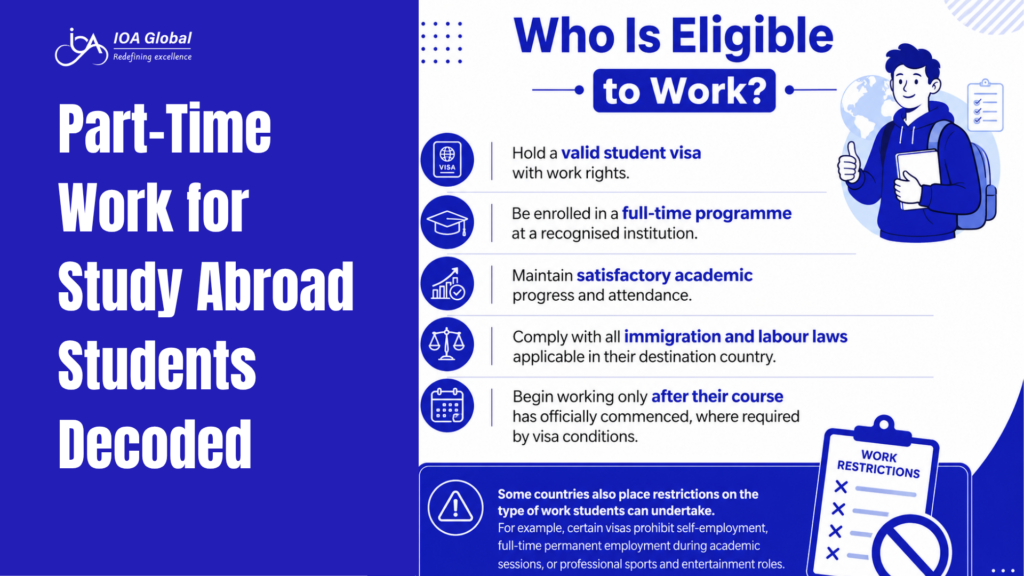
Some countries also place restrictions on the type of work students can undertake. For example, certain visas prohibit self-employment, full-time permanent employment during academic sessions, or professional sports and entertainment roles.
Why Following Visa Conditions Matters
Many students assume that exceeding the permitted work hours is a minor issue, but immigration authorities treat visa compliance seriously. Working beyond the authorised limit, accepting unauthorised employment, or failing to meet academic requirements can result in penalties such as:
- Visa warnings or cancellation.
- Loss of student status.
- Difficulties when applying for post-study work visas or permanent residency.
- Future visa refusals in the same or other countries.
Maintaining compliance protects both your academic journey and your long-term career opportunities abroad.
Does Every Student Get Automatic Work Rights?
Not necessarily. Work rights depend on factors such as:
- Your destination country.
- The type of student visa you hold.
- Your course duration and qualification level.
- The institution where you are enrolled.
- Any specific conditions printed on your visa.
For this reason, students should always read their visa conditions carefully before accepting a job. If any aspect is unclear, consult the official immigration authority or seek guidance from experienced Study Abroad Consultants who understand country-specific visa regulations.
Work During and In-Between Semesters: When Can International Students Work Full-Time?
One of the biggest advantages of studying abroad is the flexibility to work while pursuing your degree. However, the number of hours you can work depends not only on your destination country but also on your academic calendar. Most countries distinguish between term time (when classes are in session) and official semester breaks or vacations. Understanding this distinction is essential to remain compliant with your student visa conditions.
In general, international students are expected to prioritise their studies during teaching periods. As a result, governments typically restrict the number of hours students can work. During official university vacations, many countries relax these restrictions, allowing eligible students to work full-time or for longer hours. These provisions help students gain additional work experience and earn extra income during breaks without affecting their academic commitments.
Working During Academic Semesters
During the semester, international students are usually permitted to work on a part-time basis. These limits are designed to ensure that employment does not interfere with lectures, assignments, examinations, or overall academic performance.
Here’s an overview of the current work limits for popular study destinations:
| Country | During Academic Session |
| United Kingdom | Up to 20 hours per week for most full-time degree-level students. |
| Australia | Up to 48 hours per fortnight while your course is in session. |
| Ireland | Up to 20 hours per week during term. |
| New Zealand | Eligible students can work up to 25 hours per week during study. |
| Germany | Work is regulated through an annual limit (currently 140 full days or 280 half days, or an equivalent hourly arrangement). |
| France | Students can work up to the annual legal limit of 964 hours. |
| Singapore | Students enrolled at approved institutions may work up to 16 hours per week during term. |
| Dubai (UAE) | Work rights depend on visa conditions, university approval (where applicable), and employer requirements. |
Working During Semester Breaks
Official university holidays provide students with an opportunity to increase their earnings. In several countries, eligible students may work full-time during scheduled vacations, provided these breaks are recognised by both their institution and immigration authorities.
For example:
- United Kingdom: Eligible students can generally work full-time during official university vacations.
- Australia: Students may work unlimited hours during recognised course breaks.
- Ireland: Students may work up to 40 hours per week during designated holiday periods.
- New Zealand: Eligible students can work full-time during scheduled academic breaks.
- Singapore: Students studying at approved institutions may work full-time during vacations.
- Germany and France: Although work is more flexible during holidays, annual work limits continue to apply, so students should monitor their total working hours across the year.
What Counts as an “Official Semester Break”?
An important point that many students overlook is that not every gap between classes qualifies as an official vacation.
Immigration authorities generally recognise only those breaks that are:
- Included in the university’s official academic calendar.
- Approved by the educational institution.
- Part of the scheduled programme structure.
For example, finishing your exams early or taking personal leave does not automatically allow you to work additional hours if the university is still officially in session.
Why These Rules Matter
Working beyond the hours permitted by your student visa can have serious consequences. Depending on the country, violating visa conditions may result in:
- Financial penalties.
- Cancellation of your student visa.
- Difficulties obtaining a post-study work visa.
- Negative implications for future visa applications.
For this reason, students should always check both their visa conditions and their university’s academic calendar before accepting additional shifts or full-time work during breaks.
Make the Most of Your Semester Breaks
Semester breaks can be an excellent opportunity to:
- Build professional work experience.
- Save money for upcoming tuition or living expenses.
- Expand your professional network.
- Improve communication and workplace skills.
- Strengthen your CV with international work experience.
Many employers also increase hiring during holiday periods, especially in retail, hospitality, tourism, logistics, and customer service, making it easier for international students to secure temporary employment.
Rules and Regulations: What Every International Student Should Know
Working part-time while studying abroad is an excellent way to gain international work experience and supplement your living expenses. However, employment opportunities come with legal responsibilities. Every country has specific immigration, employment, and tax regulations that international students must follow. Understanding these rules before accepting a job is essential to protect your student visa status and ensure a smooth study abroad experience.
Although regulations vary by destination, there are several common rules that apply across most countries.
1. Your Primary Purpose Must Be Studying
A student visa is granted for the purpose of education. While most countries allow eligible international students to work, your academic programme must always remain your primary commitment.
Universities generally expect students to:
- Attend classes regularly.
- Meet attendance requirements.
- Complete coursework and assessments on time.
- Maintain satisfactory academic progress.
If your academic performance declines because of excessive work commitments, it may affect both your university enrolment and, in some cases, your visa status.
2. Work Only Within Your Visa Conditions
Every student visa includes conditions that specify whether you are allowed to work and, if so, how many hours you may work during term time and official breaks.
Before accepting employment, always check:
- Whether your visa includes work rights.
- Your maximum permitted working hours.
- Any restrictions on the type of employment.
- Whether you are allowed to begin working before your course starts.
Never assume that the rules are the same across all countries. Even within the same country, visa conditions may vary depending on your course level, institution, or visa category.
3. You Must Pay Taxes If Required
Many students are surprised to learn that part-time income is often taxable.
Depending on your country of study, you may need to:
- Obtain a tax identification number.
- Register with the national tax authority.
- File an annual tax return.
- Pay income tax if your earnings exceed the applicable threshold.
In some cases, taxes deducted from your salary may be refundable if your annual income falls below the taxable limit. Understanding local tax regulations can help you avoid penalties and potentially recover overpaid taxes.
4. Know Your Employment Rights
International students are generally protected by the same workplace laws as domestic employees.
This means you are typically entitled to:
- Minimum wage (where applicable).
- Safe working conditions.
- Paid breaks as required by law.
- Protection against discrimination and harassment.
- Timely payment of wages.
Employers cannot legally pay international students less simply because they are studying abroad or hold a student visa.
If an employer asks you to work “off the books,” pays below the legal wage, or refuses to provide proper employment documentation, you should avoid accepting such work and seek advice from the relevant labour authority.
5. Keep Proper Employment Records
It is good practice to maintain copies of:
- Employment contracts.
- Payslips.
- Tax documents.
- Work schedules.
- Bank statements showing salary payments.
These records may be useful for tax purposes, future visa applications, or resolving workplace disputes.
Not every job is permitted under a student visa.
Depending on your destination country, restrictions may apply to:
- Self-employment or running a business.
- Freelancing without the appropriate work authorisation.
- Permanent full-time employment during academic sessions.
- Certain regulated professions requiring professional licences.
Before accepting freelance work or gig-based employment, confirm that your visa allows these activities.
7. Follow University Policies
In addition to government regulations, some universities have their own employment guidelines.
These may include:
- Academic performance requirements.
- Attendance expectations.
- Limits for on-campus employment.
- Career services support for finding jobs.
- Approval procedures for certain work placements.
Students should regularly check updates from their university’s international student office, as institutional policies may change.
8. Stay Updated on Immigration Changes
Student visa regulations are reviewed periodically by governments and immigration authorities. Work-hour limits, post-study work rights, minimum wage rates, and employment conditions may change over time.
Rather than relying on social media posts or online forums, always verify information through official government websites or seek guidance from trusted Study Abroad Consultants who stay updated with the latest immigration policies.
Common Mistakes International Students Should Avoid
Many students unintentionally violate visa conditions because they are unaware of the rules. Some of the most common mistakes include:
- Working more hours than legally permitted.
- Accepting cash-in-hand jobs without proper documentation.
- Failing to declare taxable income.
- Ignoring university attendance requirements.
- Assuming that all countries have identical work regulations.
- Not reading the conditions printed on their student visa.
Avoiding these mistakes can help you maintain your legal status, protect your future career opportunities, and enjoy a hassle-free international education experience.
Key Takeaway
Part-time work should complement your education, not replace it. By understanding and following your visa conditions, employment laws, tax obligations, and university policies, you can gain valuable international work experience while staying fully compliant with local regulations.
Types of Part-Time Jobs Available for International Students
One of the biggest advantages of studying abroad is the wide variety of part-time employment opportunities available to international students. Whether you’re looking to gain professional experience, improve your communication skills, or simply earn extra income to support your living expenses, there are numerous roles across different industries that accommodate student schedules.
The type of job you secure depends on several factors, including your qualifications, previous work experience, English language proficiency, local language skills (where applicable), location, and the demand in your city. While some students prefer on-campus jobs because of their flexibility, others choose off-campus roles that often offer more working hours and higher earnings.
Below are the most common types of part-time jobs available to Indian and international students.
1. On-Campus Jobs
Many universities offer employment opportunities within the campus itself. These jobs are particularly popular among first-year international students because they are located close to classrooms and generally provide flexible working hours that fit around academic schedules.
Common on-campus roles include:
- Library Assistant
- Student Ambassador
- Research Assistant
- Teaching Assistant (primarily for postgraduate students)
- Laboratory Assistant
- IT Support Assistant
- Campus Tour Guide
- Administrative Assistant
- Student Services Representative
- Event Support Staff
Advantages
- Flexible work schedules.
- Minimal commuting time.
- Better understanding of academic commitments.
- Opportunity to build relationships with faculty and university staff.
- Professional work environment.
2. Hospitality Jobs
Hospitality remains one of the largest employers of international students across countries such as the UK, Australia, Ireland, and New Zealand.
Popular roles include:
- Waiter or Waitress
- Barista
- Kitchen Assistant
- Food Delivery Staff
- Restaurant Crew Member
- Bartender (subject to local laws and age restrictions)
- Hotel Reception Assistant
- Housekeeping Staff
Many hospitality jobs offer evening and weekend shifts, making them easier to balance with university classes.
3. Retail Jobs
Retail positions are another excellent option for students who enjoy customer interaction and flexible scheduling.
Common roles include:
- Sales Assistant
- Cashier
- Store Associate
- Stock Replenishment Assistant
- Customer Service Representative
- Visual Merchandising Assistant
Large supermarkets, department stores, and shopping centres frequently recruit part-time employees throughout the year, especially during holiday seasons.
4. Customer Service & Call Centre Jobs
Students with strong English communication skills may find opportunities in customer support and service-based roles.
Typical positions include:
- Customer Support Executive
- Call Centre Representative
- Help Desk Assistant
- Front Desk Executive
- Receptionist
These jobs help students develop communication, problem-solving, and interpersonal skills that are valued by employers worldwide.
5. Warehouse & Logistics Jobs
The growth of e-commerce has significantly increased demand for warehouse workers and logistics assistants in many countries.
Examples include:
- Warehouse Associate
- Parcel Sorter
- Inventory Assistant
- Order Picker and Packer
- Distribution Centre Assistant
These roles often involve physical work but may offer competitive hourly wages and weekend shifts.
6. Tutoring and Academic Support
Students with strong academic backgrounds can earn attractive hourly rates by teaching others.
Popular opportunities include:
- Private Tutor
- Online Tutor
- Language Tutor
- Mathematics Tutor
- Science Tutor
- Coding Instructor
Tutoring is often among the highest-paying part-time jobs because it requires specialised knowledge and teaching ability.
7. Freelancing and Remote Work
In some countries, international students may be permitted to undertake freelance work or remote projects, subject to their visa conditions.
Potential opportunities include:
- Graphic Design
- Content Writing
- Video Editing
- Web Development
- Digital Marketing
- Social Media Management
- Translation Services
Before accepting freelance assignments, students should confirm that their visa permits self-employment or independent contracting.
8. Internships
Many universities encourage students to undertake paid internships that are directly related to their field of study.
Internships can provide:
- Practical industry experience.
- Professional networking opportunities.
- Better career prospects after graduation.
- Higher earning potential than general part-time jobs.
- A pathway to graduate employment.
For students pursuing business, engineering, information technology, healthcare, finance, or marketing, internships often deliver greater long-term value than traditional part-time jobs.
Which Type of Part-Time Job Is Best?
There is no single “best” job for every international student. The ideal role depends on your priorities.
- If flexibility is your priority, on-campus jobs are often the best choice.
- If your goal is higher earnings, tutoring, internships, and technical freelance work generally pay more.
- If you want to improve communication skills, hospitality and retail jobs offer excellent customer-facing experience.
- If you are looking to build a career in your chosen field, industry-specific internships can provide the greatest long-term benefits.
Ultimately, the best part-time job is one that allows you to balance your academic responsibilities while developing skills that enhance your future career.
Where to Find Part-Time Jobs While Studying Abroad
Finding a part-time job abroad may seem challenging at first, especially if you’re moving to a new country for the first time. The good news is that universities, employers, and governments have made the job search process much more accessible for international students. From university career portals and networking events to online job boards and recruitment agencies, there are numerous ways to find legitimate employment opportunities while pursuing your studies.
The key is to begin your search early, prepare a country-specific CV or résumé, and apply only through trusted platforms. Avoid relying on social media posts or informal referrals that promise quick employment without proper documentation, as these may not comply with local labour laws or visa regulations.
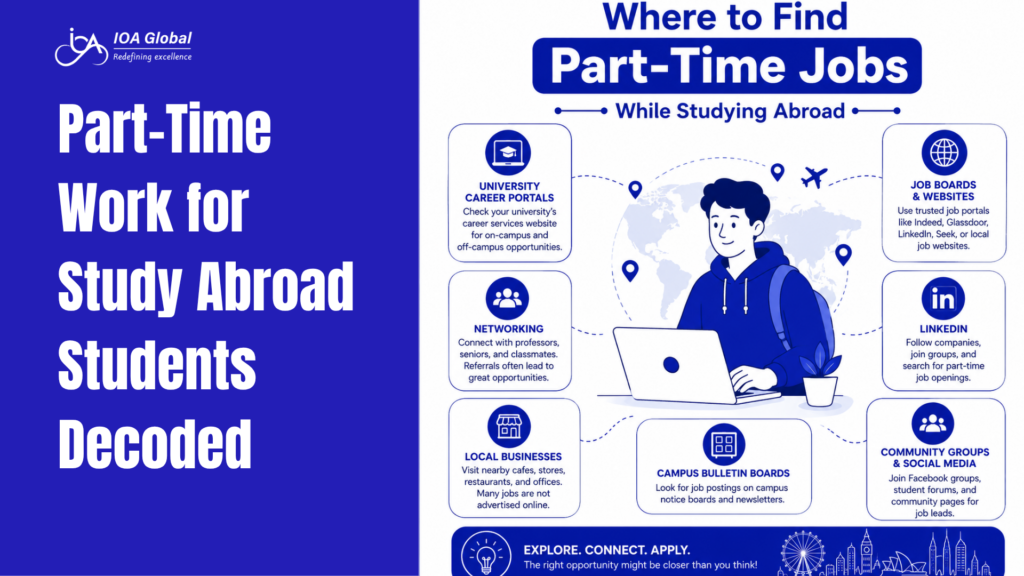
1. University Career Services
Most universities have dedicated career services or employability centres that help students find internships, graduate roles, and part-time jobs. These offices often maintain exclusive job portals where employers specifically recruit students from their institution.
Career services may also provide:
- CV and résumé reviews.
- Interview preparation workshops.
- Career counselling.
- Employer networking events.
- Job fairs and campus recruitment drives.
- Internship and placement support.
Many universities also advertise on-campus positions such as library assistants, student ambassadors, laboratory assistants, research assistants, and administrative support roles.
Why choose this option?
- Trusted employers.
- Flexible schedules designed for students.
- Roles that accommodate academic commitments.
2. Online Job Portals
Online job portals remain one of the fastest ways to search for part-time employment. Students can filter vacancies by location, working hours, industry, experience level, and salary expectations.
Some of the most popular job portals include:
| Country | Popular Job Portals |
| United Kingdom | Indeed, StudentJob UK, Reed, Totaljobs |
| Australia |
SEEK, Indeed Australia, Jora, CareerOne
|
| Ireland | Jobs.ie, IrishJobs, Indeed Ireland |
| Germany |
StepStone Germany, Indeed Germany, Make it in Germany Job Exchange
|
| New Zealand |
Seek NZ, Trade Me Jobs, Student Job Search (SJS)
|
| France |
Indeed France, Welcome to the Jungle, APEC (graduate opportunities)
|
| Singapore |
MyCareersFuture, JobStreet Singapore, FastJobs
|
| UAE (Dubai) |
Indeed UAE, Bayt, Naukrigulf, LinkedIn Jobs
|
3. LinkedIn
LinkedIn has become one of the most valuable platforms for students seeking employment abroad. In addition to job listings, it enables students to connect directly with recruiters, alumni, professors, and professionals working in their field.
To improve your chances of getting noticed:
- Complete your LinkedIn profile.
- Add a professional photograph.
- Highlight relevant skills, certifications, and projects.
- Mention your expected graduation date.
- Activate the “Open to Work” feature.
- Follow companies that regularly hire students.
Networking often leads to opportunities that are never publicly advertised.
4. University Job Fairs
Many universities organise career fairs throughout the academic year where employers meet students looking for part-time work, internships, and graduate opportunities.
Attending these events allows students to:
- Meet recruiters face-to-face.
- Learn about different industries.
- Submit their CV directly.
- Explore internship opportunities.
- Build professional connections.
Even if you are not immediately hired, career fairs are excellent networking opportunities.
5. Local Businesses
Restaurants, cafés, supermarkets, retail stores, hotels, and shopping centres frequently hire international students for flexible part-time roles.
Many small businesses advertise vacancies through:
- Posters displayed in store windows.
- Local community notice boards.
- Company websites.
- Walk-in applications.
For hospitality and retail roles, introducing yourself professionally and submitting a printed CV can sometimes be as effective as applying online.
6. Recruitment Agencies
Several countries have recruitment agencies that specialise in temporary and part-time employment.
These agencies can help students find opportunities in:
- Hospitality.
- Retail.
- Warehousing.
- Administration.
- Customer service.
- Seasonal employment.
Always ensure that the recruitment agency is licensed and does not charge illegal placement fees.
7. Networking
A significant number of student jobs are secured through referrals and professional networks.
You can expand your network by:
- Joining university clubs and societies.
- Participating in volunteering activities.
- Attending professional networking events.
- Connecting with alumni.
- Engaging with professors and classmates.
Networking not only helps students find jobs but also creates opportunities for internships and graduate employment after completing their degree.
8. Government Employment Portals
Several governments maintain official employment portals that list verified vacancies and provide career guidance.
These portals often include:
- Student-friendly vacancies.
- Labour market information.
- Salary insights.
- Employment rights.
- Industry demand reports.
Using official government resources reduces the risk of fraudulent job advertisements and helps students understand their legal rights as employees.
Tips to Improve Your Chances of Getting Hired
Competition for student jobs can be high, particularly in large cities. The following strategies can significantly improve your employability:
- Tailor your CV for each job application.
- Write a concise and professional cover letter when required.
- Apply for multiple positions rather than waiting for a single response.
- Develop strong communication and customer service skills.
- Learn the local language if studying in a non-English-speaking country.
- Be flexible with evening, weekend, and holiday shifts.
- Gain relevant certifications, such as food safety or responsible service of alcohol, where applicable.
Stay Alert to Job Scams
Unfortunately, international students can sometimes be targeted by fraudulent job offers. Be cautious if an employer:
- Requests payment to secure a job.
- Offers wages significantly higher than market rates without clear justification.
- Refuses to provide a written employment contract.
- Asks you to work beyond the legal limits of your student visa.
- Pays exclusively in cash without proper payroll records.
If something feels suspicious, verify the employer through official channels or consult your university’s career services before accepting the role.
Key Takeaway
Finding a part-time job abroad requires preparation, persistence, and an understanding of the local job market. By using university career services, trusted job portals, professional networking platforms, and official employment resources, international students can access legitimate opportunities that support both their finances and long-term career goals.
Average Hourly Pay: How Much Can International Students Earn in 2027?
One of the biggest advantages of working part-time while studying abroad is the opportunity to earn an income that helps cover day-to-day living expenses. Although part-time work is not intended to finance your entire education, it can significantly reduce your financial burden by helping you pay for groceries, transportation, utility bills, entertainment, and, in some cases, a portion of your accommodation costs.
The amount you can earn depends on several factors, including your country of study, city of residence, industry, job role, previous work experience, language proficiency, and local minimum wage laws. Students working in hospitality, retail, customer service, logistics, and on-campus roles typically earn entry-level wages, while those with specialised skills in tutoring, IT, design, or digital marketing may command higher hourly rates.
Average Hourly Earnings by Country
The table below provides an overview of the typical hourly earnings for common student jobs in popular study destinations. Actual pay may vary depending on the employer, location, and your experience.
| Country | Typical Hourly Pay | Common Student Jobs |
| United Kingdom | £12-£16 |
Retail Assistant, Barista, Wait Staff, Warehouse Operative, Student Ambassador
|
| Australia | AUD 25-35 |
Café Staff, Supermarket Team Member, Customer Service Assistant, Tutor
|
| Ireland | €13-€17 |
Hospitality Staff, Retail Associate, Administrative Assistant
|
| Germany | €13-€18 |
Research Assistant, Warehouse Associate, Café Staff, Tutor
|
| New Zealand | NZD 24-30 |
Retail Assistant, Hospitality Worker, Campus Assistant
|
| France | €12-€15 |
Restaurant Staff, Retail Sales Assistant, Language Tutor
|
| Singapore | SGD 10-16 |
Food & Beverage Crew, Retail Staff, Administrative Support
|
| Dubai (UAE) | AED 25-50 |
Customer Service, Retail Associate, Hospitality Staff
|
What Determines Your Hourly Pay?
Not every student earns the same amount. Several factors influence your hourly wage.
1. Country of Study
Each country has different labour laws, minimum wage policies, and employment demand. For example, Australia, the UK, Germany, and Ireland generally offer higher hourly wages than many other destinations, although they also have relatively higher living costs.
2. City You Live In
Major cities such as London, Sydney, Melbourne, Dublin, Auckland, and Singapore often offer more job opportunities and higher wages. However, accommodation and daily expenses in these cities are also significantly higher than in smaller towns or regional areas.
3. Industry
Certain industries consistently pay more than others.
Higher-paying sectors include:
- Information Technology
- Private Tutoring
- University Research
- Skilled Administration
- Digital Marketing
- Graphic Design
- Technical Support
Entry-level sectors commonly chosen by students include:
- Hospitality
- Retail
- Customer Service
- Supermarkets
- Warehousing
- Food Delivery
While these roles may offer lower hourly wages than specialised positions, they are generally easier for international students to obtain and often provide flexible working hours.
4. Previous Experience
Students who have prior work experience, internships, certifications, or specialised technical skills may qualify for better-paying roles. Experience in customer service, hospitality, administration, or software development can make your application more competitive.
5. Language Skills
Strong English communication skills are essential in English-speaking countries such as the UK, Australia, Ireland, and New Zealand.
In countries like Germany and France, proficiency in the local language can significantly improve your employment prospects, particularly in customer-facing roles such as retail, hospitality, and healthcare.
Can You Negotiate Your Pay?
Yes, but it depends on the role and employer.
For entry-level part-time jobs, wages are often fixed according to company policy or industry awards. However, for roles requiring specialised expertise- such as tutoring, software development, graphic design, or freelance consulting, you may have greater flexibility to negotiate your hourly rate based on your qualifications and experience.
Will You Receive Additional Benefits?
Depending on the country and employer, part-time employees may also be entitled to benefits such as:
- Overtime pay
- Holiday pay
- Weekend or public holiday loading
- Paid breaks
- Pension contributions (where applicable)
- Employee discounts
- Performance bonuses
Eligibility for these benefits varies by country and employment contract, so students should carefully review the terms of their employment before accepting an offer.
How Much Can You Earn in a Month?
Your monthly income depends on:
- The number of hours you are legally permitted to work
- Your hourly wage
- Your class schedule
- Employer availability
- Seasonal demand
For example, a student earning the local equivalent of £13–£15 per hour and working within the legal limit during the semester may earn enough to contribute meaningfully towards groceries, transport, utilities, and personal expenses. During official semester breaks, when many countries permit longer working hours, students may be able to earn substantially more.
However, part-time work should not be relied upon to pay tuition fees. Tuition, health insurance, and other major educational expenses should be planned through savings, scholarships, education loans, or family support before commencing your studies.
Key Takeaway
Part-time employment can play an important role in making overseas education more affordable while helping you gain valuable workplace experience. Rather than focusing solely on the highest hourly wage, students should consider factors such as work flexibility, proximity to campus, career relevance, and the ability to balance employment with academic responsibilities.
A well-chosen part-time job can not only ease your financial burden but also strengthen your CV, expand your professional network, and improve your employability after graduation.
Can Part-Time Work Cover Your Living Expenses?
One of the most frequently asked questions by students planning to study abroad is: “Can I support myself financially through part-time work?” The honest answer is yes, to an extent.
In most popular study destinations, part-time employment can help international students manage a significant portion of their day-to-day living expenses. However, it should not be viewed as a primary source of funding for tuition fees or the overall cost of overseas education. Student visa work rights are designed to provide financial support and practical work experience, not to replace the need for pre-arranged financial resources.
The amount you can contribute towards your expenses depends on factors such as your hourly wage, the legal work-hour limits in your destination country, your city of residence, lifestyle, and monthly budget.
What Expenses Can Part-Time Income Help Cover?
Many international students use their earnings to pay for everyday expenses, including:
- Groceries and household essentials
- Public transportation or fuel
- Mobile phone and internet bills
- Dining out and entertainment
- Clothing and personal shopping
- Utility bills (where applicable)
- Study materials and stationery
- A portion of accommodation costs, particularly when sharing housing with other students
Students who budget carefully and live in shared accommodation often find it easier to manage their monthly expenses with the help of part-time income.
What Part-Time Income Usually Cannot Cover
Although earnings from part-time work can be helpful, they are generally not sufficient to cover:
- Tuition fees
- Overseas Student Health Insurance or mandatory medical insurance
- Initial visa application costs
- Airfare
- Security deposits for accommodation
- Emergency expenses
- Large one-time purchases
This is why most countries require international students to demonstrate sufficient financial capacity before issuing a student visa.
Your Cost of Living Matters
How much your part-time income contributes depends largely on where you study.
For example:
- Students living in London, Sydney, or Singapore generally face higher accommodation and transportation costs than those studying in smaller cities.
- Students in regional areas may have lower living expenses, although job availability and hourly wages can vary.
- Sharing accommodation, cooking at home, and using student discounts can significantly reduce monthly expenses regardless of the country.
Creating a realistic monthly budget before departure can help you understand how much financial support you may need beyond your part-time earnings.
Smart Ways to Make Your Income Go Further
Many international students successfully manage their finances by combining part-time work with smart budgeting. Some practical strategies include:
- Choose shared accommodation to reduce rent
- Prepare meals at home instead of eating out regularly
- Use public transport and student travel concessions
- Take advantage of student discounts on software, entertainment, and retail purchases
- Purchase second-hand textbooks or access university library resources
- Track monthly spending using budgeting apps or spreadsheets
Small savings across multiple categories can make a meaningful difference over the course of an academic year.
Should You Depend on Part-Time Work?
It is advisable not to rely solely on part-time employment when planning your finances for studying abroad.
There are several reasons why your income may fluctuate:
- Employment opportunities may be seasonal
- Competition for student jobs can be high, particularly at the start of each semester
- Examination periods may reduce the number of hours you are able to work
- Employers may adjust staff schedules based on business demand
- Visa conditions limit the number of hours you can legally work during academic sessions
Having adequate financial resources before travelling ensures that you can focus on your studies even if finding a job takes longer than expected.
The Bigger Benefit of Part-Time Work
While earning money is undoubtedly important, the long-term value of part-time employment often extends beyond financial support.
Working during your studies can help you:
- Develop communication and interpersonal skills
- Gain international workplace experience
- Build confidence in a multicultural environment
- Improve time management and problem-solving abilities
- Expand your professional network
- Strengthen your CV for future internships and graduate roles
For many employers, practical work experience gained while studying demonstrates initiative, adaptability, and the ability to balance multiple responsibilities- qualities that are highly valued in today’s global job market.
Key Takeaway
Part-time work can make studying abroad more affordable by helping you manage many of your everyday living expenses. However, it should be viewed as a financial supplement rather than a complete funding solution. Planning your finances in advance, understanding your country’s work regulations, and maintaining a healthy balance between employment and academics will help you make the most of your international education experience.
Language Proficiency: Do You Need to Know the Local Language?
One of the biggest concerns among students planning to study abroad is whether they need to learn the local language to secure a part-time job. The answer depends on your destination country, the type of job you are applying for, and the level of interaction the role requires with customers or clients.
In English-speaking countries such as the United Kingdom, Australia, Ireland, and New Zealand, a good command of English is generally sufficient for most student jobs. Since international students are already required to demonstrate English language proficiency through recognised tests such as IELTS, PTE Academic, or other accepted qualifications during the admission process, they usually meet the basic communication requirements for entry-level roles in retail, hospitality, customer service, and on-campus employment.
However, fluency in English alone may not be enough in countries where another language is predominantly used in workplaces and public interactions.
Country-wise Language Requirements
| Country | Is English Enough? | Local Language Advantage |
| United Kingdom | Yes |
Not required for most student jobs.
|
| Australia | Yes |
Not required. Strong communication skills are valued.
|
| Ireland | Yes |
Not required. English is the primary language of work.
|
| New Zealand | Yes |
Not required for most entry-level roles.
|
| Germany | Sometimes |
Knowledge of German significantly improves job opportunities, especially in retail, hospitality, healthcare, and customer-facing roles.
|
| France | Sometimes |
French language skills are highly beneficial for most off-campus jobs.
|
| Singapore | Yes |
English is widely used in education and business. Additional languages may be useful depending on the employer.
|
| UAE (Dubai) | Yes |
English is widely accepted. Arabic can be an added advantage in certain industries.
|
Why Communication Skills Matter
Regardless of the country you choose, employers value candidates who can communicate effectively with customers, colleagues, and supervisors. Strong communication skills often influence hiring decisions as much as technical qualifications, particularly for part-time roles in hospitality, retail, and customer service.
Students who communicate confidently are also more likely to:
- Perform well in interviews
- Build positive relationships with employers
- Handle customer interactions effectively
- Progress to supervisory or higher-paying roles over time
Can Learning the Local Language Increase Your Earnings?
In many non-English-speaking countries, the answer is yes.
For example:
- In Germany, students with conversational German may qualify for a wider range of customer-facing roles and internships.
- In France, knowledge of French can improve access to hospitality, retail, and administrative positions.
- In Singapore and Dubai, multilingual candidates may have an advantage in industries such as tourism, hospitality, and international customer service.
Even basic conversational skills demonstrate initiative and make it easier to integrate into the local community.
Tips to Improve Your Employability
Before and after arriving in your destination country, consider taking steps to strengthen your communication skills:
- Practise spoken English regularly.
- Improve your interview skills.
- Learn workplace vocabulary related to your industry.
- Take beginner-level classes in the local language if studying in a non-English-speaking country.
- Participate in university language exchange programmes or conversation clubs.
These small efforts can significantly improve your confidence and employment prospects.
Time Management: Balancing Work and Academics Successfully
Working part-time while pursuing an international degree requires careful planning and discipline. Although earning extra income is beneficial, your primary responsibility as an international student is to successfully complete your academic programme.
One of the biggest challenges students face is balancing lectures, assignments, examinations, personal responsibilities, and work commitments. Without effective time management, students may experience increased stress, declining academic performance, and difficulty maintaining a healthy work-life balance.
Why Time Management Is Important
Managing your time effectively allows you to:
- Meet assignment and examination deadlines.
- Maintain good academic performance.
- Stay within your legal work-hour limits.
- Reduce stress and burnout.
- Make time for networking, extracurricular activities, and personal well-being.
Employers also appreciate students who are organised, punctual, and able to manage multiple responsibilities professionally.
Practical Time Management Tips
Plan Your Week in Advance
Use a planner or digital calendar to schedule:
- Lectures.
- Study sessions.
- Assignment deadlines.
- Work shifts.
- Personal commitments.
- Rest and recreation.
Having a clear weekly schedule helps avoid last-minute conflicts.
Prioritise Academics
During examination periods or when major assignments are due, consider reducing your work hours if possible. Remember that strong academic performance contributes more to your long-term career prospects than short-term earnings.
Choose Flexible Jobs
Many employers who regularly hire students understand academic commitments and offer:
- Evening shifts.
- Weekend work.
- Flexible rosters.
- Casual employment arrangements.
On-campus jobs are often particularly accommodating during examination periods.
Avoid Overcommitting
While it may be tempting to accept additional shifts, working excessive hours can lead to fatigue and negatively impact your studies. Always ensure that your workload remains manageable and compliant with your student visa conditions.
Take Care of Your Well-being
Balancing study and work can be demanding. Make time for:
- Adequate sleep.
- Regular exercise.
- Healthy eating.
- Social interactions.
- Mental health support when needed.
Maintaining your physical and mental well-being helps you perform better both academically and professionally.
Part-Time Work Opportunities Across Different Study Abroad Destinations
One of the biggest advantages of studying abroad is that many countries allow international students to work while pursuing their education. However, work rights, earning potential, labour laws, language requirements, and the availability of student-friendly jobs vary significantly from one destination to another.
While some countries offer higher hourly wages, others provide lower living costs or greater flexibility in work regulations. Therefore, students should evaluate employment opportunities alongside factors such as tuition fees, career prospects, post-study work opportunities, and overall cost of living before choosing a study destination.
The table below compares the most popular countries for international students based on key employment-related factors.
| Factor | UK | Australia | Ireland | Germany | New Zealand |
| Student Work Rights | Permitted under eligible Student visa conditions | Permitted under eligible Student visa conditions | Permitted under eligible immigration permission | Permitted under German student residence rules | Permitted for eligible Student Visa holders |
| Work During Study | Up to 20 hours/week (eligible students) | Up to 48 hours/fortnight | Up to 20 hours/week | Annual work-day limit applies | Up to 25 hours/week (eligible students) |
| Work During Official Breaks | Full-time | Unlimited during recognised breaks | Up to 40 hours/week during eligible holiday periods | Subject to annual limits | Full-time (where eligible) |
| Typical Hourly Earnings | High | Very High | High | High | High |
| Availability of Student Jobs | Excellent | Excellent | Very Good | Good | Very Good |
| On-Campus Employment | Available | Widely Available | Available | Available | Available |
| Hospitality & Retail Jobs | Excellent | Excellent | Excellent | Good | Excellent |
| Local Language Required? | No | No | No | Helpful for many roles | No |
| Career-Relevant Internships | Excellent | Excellent | Very Good | Excellent | Very Good |
| Overall Student Employment Opportunities | ★★★★★ | ★★★★★ | ★★★★☆ | ★★★★☆ | ★★★★☆ |
Which Country Offers the Best Part-Time Work Opportunities?
The answer depends on your priorities rather than a single “best” destination.
If Your Priority Is Higher Earnings
Students looking to maximise their hourly income often consider:
- Australia
- United Kingdom
- Germany
- Ireland
These countries generally offer competitive wages, mature labour markets, and a wide range of student-friendly jobs.
If You Want Plenty of Job Opportunities
The hospitality, retail, logistics, and customer service sectors regularly recruit international students in:
- Australia
- United Kingdom
- Ireland
- New Zealand
Large metropolitan cities in these countries tend to have a higher demand for part-time workers throughout the year.
If You Want Career-Relevant Experience
Students pursuing fields such as engineering, business, information technology, healthcare, or research may benefit from destinations where internships and university-industry collaborations are well established, including:
- Germany
- United Kingdom
- Australia
- Singapore
Practical experience gained during your studies can strengthen your CV and improve your prospects for graduate employment.
If You Are Studying in a Non-English-Speaking Country
Countries such as Germany and France offer excellent education and career opportunities, but learning the local language can significantly improve your employability, especially in customer-facing roles. Students who invest time in developing conversational language skills often have access to a wider range of part-time jobs.
Factors to Consider Beyond Salary
While higher hourly wages may seem attractive, they should not be the only factor influencing your decision. Before choosing a study destination, consider:
- Tuition fees.
- Monthly cost of living.
- Availability of student accommodation.
- Public transport costs.
- Post-study work opportunities.
- Graduate employment rates.
- Industry demand in your chosen field.
- Quality of life.
- Immigration policies.
A country with slightly lower wages but lower living expenses and stronger career opportunities may provide better long-term value than a destination with higher salaries but significantly higher costs.
Top 10 Best Part-Time Jobs for Indian & International Students
The best part-time job isn’t necessarily the one that pays the highest. As an international student, you should also consider flexibility, proximity to campus, career relevance, required skills, and how well the job fits around your academic schedule.
The roles below are among the most popular and accessible for international students across the UK, Australia, Ireland, Germany, New Zealand, France, Singapore, and Dubai.
Top 10 Part-Time Jobs Comparison
| Job Role | Popular Countries | Typical Hourly Pay* | Skills Required | Best For |
| Retail Sales Assistant | UK, Australia, Ireland, New Zealand, Singapore, Dubai | Moderate | Customer service, communication, teamwork | Students looking for flexible shifts and weekend work |
| Barista / Café Assistant | UK, Australia, Ireland, France, New Zealand | Moderate | Communication, multitasking, customer service | Students who enjoy fast-paced environments |
| Waiter / Waitress | UK, Australia, Ireland, France, Dubai | Moderate to High (tips may apply) | Customer service, teamwork, time management | Hospitality and tourism students |
| Library Assistant | UK, Australia, Germany, New Zealand | Moderate | Organisation, attention to detail | Students seeking quiet, on-campus work |
| Student Ambassador | UK, Australia, Ireland | Moderate | Public speaking, communication, leadership | Students interested in networking and university engagement |
| Research Assistant | UK, Germany, Australia, France | High | Academic excellence, research, analytical skills | Primarily postgraduate and research students |
| Private Tutor | All major destinations | High | Subject expertise, communication, patience | Students with strong academic backgrounds |
| Warehouse Associate | UK, Australia, Germany, Ireland | Moderate to High | Physical fitness, organisation | Students seeking weekend or holiday work |
| Administrative Assistant | UK, Australia, Singapore, Germany | Moderate to High | Computer skills, communication, organisation | Business, management, and office administration students |
| Digital Marketing / Content Freelancer† | Most countries (subject to visa conditions) | High | SEO, writing, design, social media, analytics | Students with digital and creative skills |
A Closer Look at the Best Student Jobs
1. Retail Sales Assistant
Retail is one of the largest employers of international students worldwide. Supermarkets, department stores, convenience stores, and shopping centres frequently hire part-time staff for evening and weekend shifts.
Why it’s a good choice:
- Flexible working hours.
- No specialised qualifications required for many entry-level roles.
- Opportunity to improve communication and customer service skills.
- Valuable experience for future careers in sales, marketing, and business.
2. Barista or Café Assistant
Coffee shops and cafés often recruit students because they require employees who can work around peak morning, evening, and weekend hours.
Students gain experience in:
- Customer interaction.
- Cash handling.
- Teamwork.
- Working under pressure.
Many employers also provide on-the-job training, making these roles accessible even without prior hospitality experience.
3. Waiter or Waitress
Restaurants, hotels, and hospitality venues regularly hire international students. In some countries, eligible employees may also receive tips in addition to their hourly wage, depending on workplace practices.
This role helps develop:
- Communication skills.
- Problem-solving.
- Multitasking.
- Professional confidence.
4. Library Assistant
Library jobs are highly sought after because they are usually located on campus and offer a quieter work environment than hospitality or retail.
Responsibilities may include:
- Shelving books.
- Assisting students.
- Managing library resources.
- Administrative support.
These roles often fit well around academic timetables.
5. Student Ambassador
Many universities recruit current students to represent the institution during open days, campus tours, orientation programmes, and promotional events.
This role is particularly beneficial for students interested in:
- Marketing.
- Public relations.
- Event management.
- Leadership.
It also provides excellent networking opportunities with university staff and prospective employers.
6. Research Assistant
Research assistantships are among the most career-relevant part-time opportunities, particularly for postgraduate students.
Typical responsibilities include:
- Literature reviews.
- Data collection and analysis.
- Laboratory support.
- Academic writing.
- Project coordination.
These roles strengthen academic profiles and may lead to future research or doctoral opportunities.
7. Private Tutor
Tutoring consistently ranks among the highest-paying part-time jobs available to students.
Popular subjects include:
- Mathematics.
- Science.
- English.
- Computer programming.
- Business.
- Test preparation.
Online tutoring platforms have also expanded opportunities for students to teach remotely, subject to visa conditions.
8. Warehouse Associate
Warehousing and logistics roles have grown significantly with the expansion of e-commerce.
Students often appreciate these jobs because they:
- Offer evening and weekend shifts.
- May provide competitive hourly wages.
- Require limited customer interaction.
However, they can involve physically demanding tasks and long periods of standing.
9. Administrative Assistant
Office-based administrative roles are ideal for students pursuing business, management, finance, or related fields.
Students gain practical experience in:
- Microsoft Office.
- Data entry.
- Scheduling.
- Professional communication.
- Office administration.
These transferable skills are valuable across many industries.
10. Digital Marketing or Content Roles
Students with experience in writing, graphic design, SEO, social media management, web development, or analytics may find opportunities with startups, agencies, or university departments.
These roles are particularly valuable because they:
- Build industry-relevant experience.
- Strengthen professional portfolios.
- May lead to internships or graduate employment.
Students should always ensure that any freelance or contract work complies with their visa conditions.
Which Job Should You Choose?
The right part-time job depends on your individual goals.
- If flexibility is your priority: On-campus roles, retail, and library jobs are excellent options.
- If you want to maximise your earnings: Tutoring, research assistantships, and specialised digital roles often offer higher pay.
- If your focus is career development: Internships, research positions, administrative roles, and university ambassador programmes provide experience that aligns closely with future graduate careers.
- If you’re new to the workforce: Hospitality and retail roles are often the easiest entry points and help build valuable interpersonal and workplace skills.
Highest-Paying Part-Time Jobs for International Students by Country (2027)
Although hospitality and retail jobs are the most common choices for international students, they are not always the highest-paying. Students with specialised skills, relevant academic backgrounds, or strong communication abilities can often secure better-paying positions that also contribute to their long-term career development.
The availability of these roles depends on factors such as visa conditions, local labour market demand, language proficiency, academic qualifications, and previous work experience. While some positions are open to undergraduate students, others, such as research or teaching assistantships are more commonly available to postgraduate students.
The tables below highlight some of the highest-paying part-time opportunities across major study destinations.
United Kingdom
| Job Role | Typical Pay | Suitable For | Notes |
| Private Tutor | High | UG & PG | Strong demand for STEM, business, and English tutors. |
| Student Ambassador | Moderate to High | UG & PG | Flexible, on-campus role with networking opportunities. |
| Research Assistant | High | Primarily PG | Ideal for students involved in academic research. |
| Administrative Assistant | Moderate to High | UG & PG | Valuable office and organisational experience. |
| Digital Marketing Assistant | Moderate to High | UG & PG | Suitable for students with content or marketing skills. |
Australia
| Job Role | Typical Pay | Suitable For | Notes |
| Private Tutor | High | UG & PG |
Strong demand across school and university subjects.
|
| Disability Support Worker* | High | Eligible students |
May require additional training, certifications, or clearances.
|
| Research Assistant | High | Primarily PG |
Common in research-intensive universities.
|
| Hospitality Supervisor | Moderate to High | Experienced students |
Prior hospitality experience may be beneficial.
|
| Warehouse Associate | Moderate to High | UG & PG |
Weekend and evening shifts are widely available.
|
Ireland
| Job Role | Typical Pay | Suitable For | Notes |
| Tutor | High | UG & PG |
Popular in mathematics, science, and English.
|
| Administrative Assistant | Moderate to High | UG & PG |
Office-based work with transferable skills.
|
| Student Ambassador | Moderate | UG & PG |
University-led recruitment and events.
|
| Retail Supervisor | Moderate to High | Experienced students |
Leadership experience may be required.
|
| Research Assistant | High | Primarily PG |
Academic and laboratory support roles.
|
Germany
| Job Role | Typical Pay | Suitable For | Notes |
| Research Assistant (HiWi) | High | UG & PG |
Common at German universities, particularly in technical fields.
|
| Tutor | High | UG & PG |
Strong demand in engineering, mathematics, and sciences.
|
| IT Support Assistant | High | Students with technical skills |
Programming or systems knowledge may be required.
|
| Laboratory Assistant | Moderate to High | Science students |
Often linked to university departments.
|
| Warehouse Associate | Moderate | UG & PG |
Local language skills may improve opportunities.
|
New Zealand
| Job Role | Typical Pay | Suitable For | Notes |
| Tutor | High | UG & PG |
Flexible and well-suited to academically strong students.
|
| Student Ambassador | Moderate | UG & PG |
University recruitment and orientation events.
|
| Retail Team Leader | Moderate to High | Experienced students |
Customer service experience preferred.
|
| Administrative Assistant | Moderate | UG & PG |
Good for business and management students.
|
| Hospitality Staff | Moderate | UG & PG |
Strong demand in tourism centres.
|
Which Jobs Offer the Best Long-Term Career Value?
While pay is important, students should also consider how a role contributes to their future career.
The following jobs provide both income and valuable professional experience:
- Research Assistant- Ideal for students pursuing higher education or research careers.
- Administrative Assistant- Builds organisational, communication, and office management skills.
- Student Ambassador- Develops leadership, public speaking, and networking abilities.
- Digital Marketing Assistant- Offers practical experience in one of the fastest-growing industries globally.
- Private Tutor- Enhances communication, teaching, and problem-solving skills while often providing attractive hourly earnings.
Students who align their part-time work with their academic discipline often graduate with stronger CVs, practical experience, and professional references advantages that can make a meaningful difference when applying for internships or graduate positions.
Pros & Cons of Working Part-Time While Studying Abroad
Working part-time while pursuing an international degree offers numerous advantages beyond earning an income. It helps students gain real-world experience, develop transferable skills, and become more independent. However, balancing work with academics also comes with challenges. Understanding both the benefits and potential drawbacks can help students make informed decisions and plan their study abroad journey effectively.
Pros of Part-Time Work
1. Helps Manage Living Expenses
One of the biggest advantages of part-time employment is the ability to contribute towards everyday expenses such as groceries, transport, mobile bills, and leisure activities. While part-time work may not cover tuition fees, it can significantly reduce your monthly financial burden.
2. Builds International Work Experience
Employers increasingly value candidates who have practical workplace experience. Working in an international environment helps students understand professional expectations, workplace culture, customer service standards, and teamwork in a multicultural setting.
3. Improves Communication and Interpersonal Skills
Many student jobs involve regular interaction with customers, colleagues, and supervisors. These experiences help improve communication, problem-solving, adaptability, and teamwork, skills that are valuable across all industries.
4. Strengthens Your CV
Relevant work experience, internships, research assistantships, or on-campus roles can enhance your résumé and make you more competitive for graduate jobs or post-study work opportunities.
5. Expands Your Professional Network
Part-time jobs provide opportunities to connect with employers, professors, colleagues, and professionals in your field. These connections can lead to internships, references, and future career opportunities.
6. Develops Financial Responsibility
Managing earnings, budgeting for expenses, and balancing work with studies help students become more financially disciplined and independent.
Cons of Part-Time Work
1. Balancing Work and Academics Can Be Challenging
Working while studying requires careful time management. Long shifts, particularly during examination periods, may affect academic performance if not managed effectively.
2. Visa Restrictions Limit Working Hours
International students must comply with the work-hour limits attached to their student visa. These restrictions may reduce earning potential compared to full-time employment.
3. Jobs May Not Be Available Immediately
Finding a suitable part-time job can take time, especially at the beginning of an academic term when many students are applying for similar roles. Students should therefore avoid relying on immediate employment to meet essential expenses.
4. Physically Demanding Roles
Jobs in hospitality, retail, logistics, and warehousing often require standing for long periods, lifting items, or working late evenings and weekends. These roles can be physically demanding, particularly when combined with academic commitments.
5. Language Barriers
In countries where English is not the primary language, limited proficiency in the local language may reduce the range of available job opportunities, especially in customer-facing roles.
6. Stress and Fatigue
Balancing coursework, deadlines, employment, and personal responsibilities can sometimes lead to stress or burnout. Maintaining a healthy routine and seeking support when needed is essential.
Is Part-Time Work Worth It?
For most international students, the answer is yes, provided it is approached responsibly.
A well-chosen part-time job can help you:
- Gain practical work experience.
- Improve employability.
- Build confidence.
- Develop transferable skills.
- Support your living expenses.
- Expand your professional network.
However, employment should complement your education rather than compete with it. Prioritising academics, following visa regulations, and maintaining a healthy work-life balance are key to making the most of your study abroad experience.
Why Choose IOA Global for Your Study Abroad Journey?
Planning to study abroad involves much more than selecting a university. Choosing the right destination, understanding visa requirements, preparing strong applications, identifying scholarship opportunities, and planning your finances all play an important role in achieving your academic and career goals.
At IOA Global, we believe that every student’s journey is unique. Our experienced counsellors provide personalised guidance to help students make informed decisions based on their academic background, career aspirations, and financial considerations.
Our Services Include:
- Personalised university and course selection.
- Country-specific admission guidance.
- Student visa application assistance.
- Scholarship and financial aid guidance.
- Education loan support.
- SOP, LOR, and application review.
- IELTS and PTE coaching support.
- Pre-departure guidance.
- Accommodation assistance.
- Career and post-study work counselling.
Whether you’re planning to study in the UK, Australia, Ireland, Germany, France, New Zealand, Singapore, or Dubai, our team supports you at every stage of the admission process.
If you’re searching for Top Study Abroad Consultants in Delhi, experienced guidance on IELTS Coaching in Delhi and PTE Coaching in Delhi, IOA Global is committed to helping you make confident, well-informed decisions for your future.
Frequently Asked Questions (FAQs)
1. Can international students work while studying abroad?
Yes. Most popular study destinations allow eligible international students to work part-time while studying, subject to the conditions of their student visa and local immigration regulations.
2. How many hours can international students work?
Working-hour limits vary by country. For example, eligible students in the UK may work up to 20 hours per week during term time, while Australia currently allows eligible students to work up to 48 hours per fortnight during study periods. Always check the latest official immigration guidance for your destination.
3. Can I work full-time during university holidays?
In many countries, eligible students are permitted to work full-time during official academic breaks. However, this depends on your visa conditions and your university’s academic calendar.
4. Is IELTS or PTE required to get a part-time job?
No. IELTS or PTE scores are typically required for university admission and visa purposes rather than employment. However, strong English communication skills are important for many part-time jobs.
5. Which country offers the highest-paying part-time jobs for students?
Countries such as Australia, the UK, Germany, and Ireland generally offer competitive hourly wages. However, earning potential should always be considered alongside the cost of living and visa regulations.
6. Can part-time work pay my tuition fees?
In most cases, no. Part-time work is intended to supplement living expenses rather than cover tuition fees or the full cost of studying abroad.
7. Do I need to know the local language?
Not always. English is sufficient for many jobs in countries such as the UK, Australia, Ireland, New Zealand, Singapore, and Dubai. In countries like Germany and France, knowledge of the local language can improve your employment prospects.
8. Are on-campus jobs better than off-campus jobs?
Both have advantages. On-campus jobs often provide greater flexibility around academic schedules, while off-campus jobs may offer a wider range of opportunities and, in some cases, higher earnings.
9. Can international students do internships while studying?
Yes, many universities encourage internships, particularly those related to your field of study. Eligibility depends on your course structure, visa conditions, and employer requirements.
10. How can IOA Global help me study abroad?
IOA Global provides end-to-end support, including university selection, application guidance, visa assistance, scholarship advice, English language coaching support, and pre-departure services to help students successfully pursue international education.
Part-time work can enrich your study abroad experience by providing financial support, professional exposure, and valuable life skills. When approached responsibly and within the conditions of your student visa, it allows you to gain international work experience, develop transferable skills, and build a strong foundation for your future career.
However, choosing the right country involves more than comparing hourly wages. Factors such as tuition fees, cost of living, employment opportunities, post-study work rights, and long-term career prospects should all be considered before making a decision.
If you’re planning to study overseas and need expert guidance on university selection, admissions, visas, scholarships, or career planning, IOA Global is here to help you navigate every step of your journey with confidence.

Leave A Comment