

Cost of Living Abroad for Indian Students: USA, Canada, UK, and Australia Compared
If you’re an Indian student planning to study abroad, one of the first things you’ll want to figure out is how much it’s actually going to cost you to live there. And not just tuition fees; we’re talking rent, groceries, transport, health insurance, the works.
The general consensus is that the USA tends to be the most money-intensive of the four major study destinations. Australia and Canada sit in the middle, and the UK, surprisingly, tends to be the most pocket-friendly option overall. That said, these are broad strokes. Where you live within a country, your housing choices, and your personal lifestyle can change the picture dramatically.
Here’s a detailed breakdown across the four countries so you can plan your finances before you land.
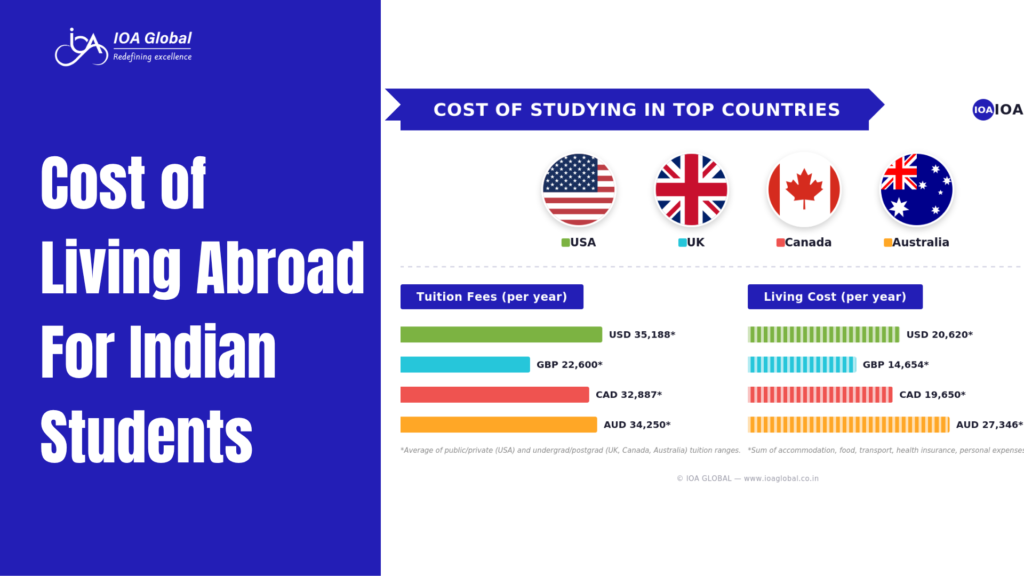
Tuition Fees
Before you even think about groceries or rent, tuition is the big number you need to plan around.
USA: For international students, public university fees average around USD 25,415 per year for out-of-state/international students, while private universities average USD 44,961. Top-ranked universities can charge USD 59,000 to USD 71,000 annually.
Canada:. On average, international undergraduate students in Canada pay CAD 41,746 per year and international graduate students pay CAD 24,028 per year, according to Statistics Canada (2026).
UK: For international undergraduate students, annual tuition fees typically range from GBP 11,400 to GBP 38,000. Postgraduate Master’s degrees usually have fees between GBP 9,000 and GBP 32,000 annually.
Australia: For international students, undergraduate Bachelor’s degrees cost AUD 20,000 to AUD 45,000 annually, and postgraduate Master’s degrees run AUD 22,000 to AUD 50,000 annually.
| Country | Level | Annual Tuition Fee |
|---|---|---|
| USA | Public University | USD 25,415 |
| USA | Private University | USD 44,961 |
| USA | Top-Ranked University | USD 59,000 – 71,000 |
| Canada | Undergraduate | CAD 41,746 |
| Canada | Graduate | CAD 24,028 |
| UK | Undergraduate | GBP 11,400 – 38,000 |
| UK | Postgraduate (Master’s) | GBP 9,000 – 32,000 |
| Australia | Undergraduate | AUD 20,000 – 45,000 |
| Australia | Postgraduate (Master’s) | AUD 22,000 – 50,000 |
*Figures are average/typical annual tuition fees and may vary by university and program.
Accommodation
Where you live will probably be your second-biggest monthly expense, and the options and costs vary quite a bit.
USA: US universities and colleges charge between USD 5,000 to USD 8,000 per year on average for on-campus accommodation. If you move off campus, rental costs usually range from USD 6,000 to USD 15,000 annually, depending on neighborhood, space, and amenities.
Canada: On-campus housing in Canada runs CAD 8,000 to CAD 10,000 per year. Shared apartments off campus range from CAD 400 to CAD 700 per month in smaller cities, though major hubs like Toronto and Vancouver will be significantly higher. Rents for one-bedroom apartments in Vancouver and Toronto did decrease by 5% in Q1 2025 compared to Q1 2024, which is a small relief.
UK: Student halls in London cost around GBP 848 per month, while in other cities they average GBP 664. Private accommodation is slightly lower, at GBP 750 per month in London and GBP 554 elsewhere.
Australia: Costs here depend heavily on your housing type. On-campus accommodation is between AUD 110 and AUD 280 per week. Hostels and guesthouses fall between AUD 90 and AUD 150 per week. Shared rentals typically range from AUD 95 to AUD 215 per week, and independent rentals go from AUD 185 to AUD 440 per week. Homestays cost between AUD 235 and AUD 325 per week.
| Country | Housing Type | Cost |
|---|---|---|
| USA | On-Campus | USD 5,000 – 8,000 / year |
| USA | Off-Campus Rental | USD 6,000 – 15,000 / year |
| Canada | On-Campus | CAD 8,000 – 10,000 / year |
| Canada | Shared Apartment (Off-Campus) | CAD 400 – 700 / month |
| UK | Student Halls (London) | GBP 848 / month |
| UK | Student Halls (Other Cities) | GBP 664 / month |
| UK | Private Accommodation (London) | GBP 750 / month |
| UK | Private Accommodation (Other Cities) | GBP 554 / month |
| Australia | On-Campus | AUD 110 – 280 / week |
| Australia | Hostels / Guesthouses | AUD 90 – 150 / week |
| Australia | Shared Rental | AUD 95 – 215 / week |
| Australia | Independent Rental | AUD 185 – 440 / week |
| Australia | Homestay | AUD 235 – 325 / week |
*Costs vary by city, housing type, and demand. Major hubs (e.g. Toronto, Vancouver, London) typically run higher than the averages shown.
Food and Groceries
This is one area where your habits make a big difference.
USA: International students spend about USD 300 to USD 600 per month on food. Cooking at home costs around USD 200 to USD 350, while eating out frequently can increase monthly expenses to USD 700 or more. A typical campus meal plan averages USD 570 per month.
Canada: Expect to spend CAD 300 to CAD 800 per month on food overall. A meal out typically costs CAD 10 to CAD 15, and groceries run between CAD 350 and CAD 800 per month.
UK: In London, eating out tends to cost around GBP 150 per month, while in other cities it’s closer to GBP 80. Grocery bills in London average GBP 155, and GBP 116 in other cities.
Australia: Both eating out and grocery expenses in Australia generally fall between AUD 140 and AUD 280 per month each.
| Country | Expense Type | Cost |
|---|---|---|
| USA | Overall Food Budget | USD 300 – 600 / month |
| USA | Cooking at Home | USD 200 – 350 / month |
| USA | Frequent Eating Out | USD 700+ / month |
| USA | Campus Meal Plan | USD 570 / month |
| Canada | Overall Food Budget | CAD 300 – 800 / month |
| Canada | Meal Out | CAD 10 – 15 / meal |
| Canada | Groceries | CAD 350 – 800 / month |
| UK | Eating Out (London) | GBP 150 / month |
| UK | Eating Out (Other Cities) | GBP 80 / month |
| UK | Groceries (London) | GBP 155 / month |
| UK | Groceries (Other Cities) | GBP 116 / month |
| Australia | Eating Out | AUD 140 – 280 / month |
| Australia | Groceries | AUD 140 – 280 / month |
*Costs vary based on lifestyle and location. Eating out frequently typically costs more than cooking at home.
Getting Around
USA: A monthly public transport pass costs between USD 70 and USD 150. If you own a car, budget USD 200 to USD 400 per month for all related expenses.
Canada: Public transport costs around CAD 80 to CAD 150 per month.
UK: A monthly travel card in London costs around GBP 103. In other cities, it drops to roughly GBP 54. Students with a Student Oyster Card can get 30% off standard tube and bus fares, which is a handy saving.
Australia: Public transport will cost you AUD 15 to AUD 55 per week, while owning a car can add AUD 150 to AUD 260 per week to your budget.
| Country | Public Transport | Owning a Car |
|---|---|---|
| USA | USD 70 – 150/month | USD 200 – 400/month |
| Canada | CAD 80 – 150/month | – |
| UK | GBP 103/month (London) GBP 54/month (other cities) Student Oyster Card: 30% off |
– |
| Australia | AUD 15 – 55/week | AUD 150 – 260/week |
Health Insurance
This is a non-negotiable expense in most countries and one that students often underestimate.
USA: Health insurance for international students costs approximately USD 1,500 to USD 2,500 per year.
Canada: Coverage runs between CAD 600 and CAD 900 annually.
UK: The NHS surcharge for student visas is GBP 776 per year, which covers both the student and any dependent family members.
Australia: International students are required to hold Overseas Student Health Cover (OSHC), which costs around AUD 806 per year.
| Country | Health Coverage | Annual Cost | |
|---|---|---|---|
| USA | International Student Health Insurance | USD 1,500 – 2,500/year | |
| Canada | Health Coverage | CAD 600 – 900/year | |
| UK | NHS Surcharge | GBP 776/year | |
| Australia | OSHC (Overseas Student Health Cover) | AUD 806/year |
Personal Expenses and Utilities
The smaller costs add up faster than you’d expect.
USA: Personal expenses typically range from USD 100 to USD 300 per month.
Canada: Utilities and cable cost around CAD 100 per month. A phone plan is roughly CAD 60, and internet runs CAD 50 to CAD 100 per month.
UK: Entertainment costs approximately GBP 10 to GBP 50 per month. Wi-Fi is around GBP 25 to GBP 50 per month, and miscellaneous spending adds another GBP 20 to GBP 50 monthly.
Australia: Electricity and gas cost AUD 35 to AUD 140 per week. Entertainment comes to AUD 80 to AUD 150, and your phone and internet bill will be around AUD 20 to AUD 55 per week.
| Country | Utilities | Entertainment | Phone & Internet |
|---|---|---|---|
| USA | Personal expenses: USD 100 – 300/month (all included) | ||
| Canada | CAD 100/month Utilities & cable |
— | Phone: CAD 60/month Internet: CAD 50 – 100/month |
| UK | Wi-Fi: GBP 25 – 50/month Misc: GBP 20 – 50/month |
GBP 10 – 50/month | — |
| Australia | Electricity & gas: AUD 35 – 140/week |
AUD 80 – 150/week | AUD 20 – 55/week |
Books and Study Materials
An often-overlooked but real expense.
USA: Budget USD 500 to USD 1,500 per year for textbooks and academic supplies.
Canada: Around CAD 250 to CAD 350 annually.
UK: Approximately GBP 21 per month.
Australia: AUD 500 to AUD 1,000 per year.
| Country | Textbooks & Academic Supplies |
|---|---|
| USA | USD 500 – 1,500/year |
| Canada | CAD 250 – 350/year |
| UK | GBP 21/month |
| Australia | AUD 500 – 1,000/year |
Practical Tips to Save Money While Studying Abroad
No matter which country you choose, the basics of budgeting stay the same.
Separate your needs from your wants. It sounds obvious, but when you’re in a new country and everything feels exciting, it’s easy to overspend. Keep your essential costs (rent, food, transport, tuition) separate from discretionary spending and always cover the essentials first.
Cook at home as often as you can. Eating out even a few extra times a week can quietly drain your budget. Buying groceries and cooking your own meals, especially with flatmates, can save a surprising amount each month.
Use public transport. Most cities in these countries have solid public transport networks, and students usually qualify for discounts. Owning a car abroad comes with a lot of hidden costs, from insurance to parking, so it’s worth avoiding unless absolutely necessary.
Build an emergency fund. Ideally, set aside three to six months’ worth of expenses before
you leave. Unexpected situations, medical emergencies, equipment breakdowns, travel disruptions, do come up, and having a financial cushion means you won’t have to panic when they do.
Watch out for common money mistakes. Over-relying on credit cards, skipping an emergency fund, and not tracking monthly spending are the three traps that catch most international students off guard. Get ahead of these before they become a problem.
Frequently Asked Questions
How much does studying abroad cost on average in 2025? It depends on the country and university. In the USA, total annual costs (tuition plus living expenses) can range from USD 20,000 to USD 85,000 per year.
How much should I carry when I first travel abroad? This depends on your destination. For the UK, for instance, you’d generally need GBP 900 to GBP 1,400 per month to cover living costs comfortably.
What kind of part-time work can international students do? On-campus jobs like library assistant or teaching assistant roles are popular options. Off campus, students often take up freelancing, retail, or babysitting to supplement their income.
How do I find budget-friendly accommodation abroad? Start by browsing student housing platforms online and comparing costs across different neighbourhood or housing types. Study abroad consultants can also help connect you with affordable, verified accommodation options.
The numbers in this article give you a solid starting point, but remember that your actual costs will depend on the city you’re in, the lifestyle choices you make, and how carefully you plan and it is often advisable to consult an expert for advise for this. IOA Global is one of the best study abroad consultants in Delhi which can help you with assessing your needs and costs accurately. Getting your budget right before you land will make the whole experience a lot less stressful.

Leave A Comment